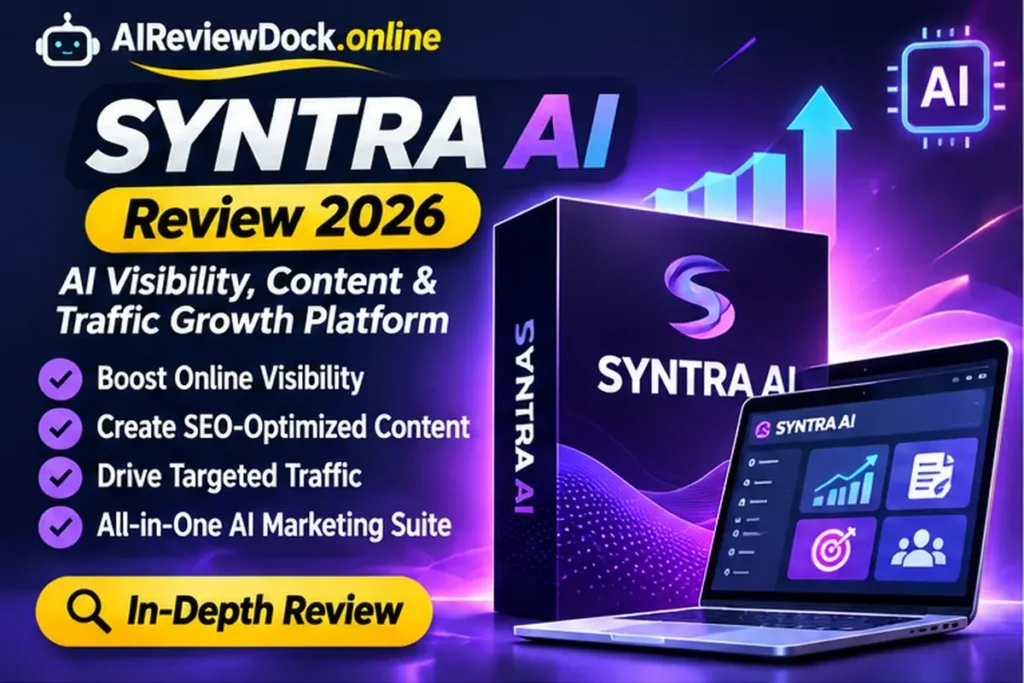
SYNTRA AI review 2026: Businesses increasingly wonder whether AI assistants mention their products when people ask for recommendations. SYNTRA, a LaunchPad offer from Art Flair launched on November 3, 2026, is marketed as an AI visibility and answer-engine optimization toolkit. Its strongest potential use is not magically injecting links into AI responses; it is helping marketers investigate brand mentions, competing recommendations and possible website improvements. This independent buyer guide examines nine practical checks, pricing risks, search policies and the difference between a measurable report and a sales promise.
We have inspected the current LaunchPad affiliate listing and publicly available product descriptions, but we have not purchased SYNTRA or independently run its dashboard. Any feature attributed to the seller is a marketed capability requiring demonstration. We do not promise search rankings, traffic, citations, leads or commissions. If you need a defensible buying decision rather than a countdown-timer pitch, read the evidence, test plan and alternatives below before opening checkout.
Affiliate disclosure: This article has four clearly labeled partner checkout buttons. AI Review Dock may receive a commission at no extra cost if you purchase through one of them. Editorial recommendations are based on what can be verified and on practical buyer checks, not a promise of earnings.
View SYNTRA AI Offer and Verify Current Checkout
SYNTRA AI Review 2026: Quick Product Overview
| Question | What we can establish |
|---|---|
| Product and category | SYNTRA; AI visibility, brand-mention monitoring and website optimization |
| Creator / network | Art Flair; LaunchPadJV offer #591 |
| Launch | November 3, 2026 |
| Advertised purpose | Check whether AI answers mention a brand, inspect competitors and suggest corrective content or markup |
| Price | A limited-time launch offer is advertised; verify the payable amount and all extras on checkout |
| Testing status | Editorial desk research; no direct software account or measured customer results |
| Best initial fit | Site owners and marketers with a brand, specific buyer questions and a repeatable baseline |
SYNTRA should not be confused with Sintra X, an unrelated AI-helper subscription service. Similar names are a reason to verify the developer, destination domain and receipt. An offer that promises exposure across billions of AI interactions is describing potential audience size, not proof that the buyer’s link appears in any meaningful proportion of those conversations. Neither LaunchPad’s affiliate sales count nor third-party testimonials establish an individual business outcome.
What Does SYNTRA Actually Claim to Do?
The listing positions SYNTRA around generative-engine optimization: understanding how brands appear in answers from assistants such as ChatGPT, Claude, Gemini and Grok. Public walkthroughs describe a process in which a marketer enters a brand, defines realistic customer prompts, runs visibility checks and reviews the names or competitors appearing in the returned answers. Another advertised layer offers a website audit and possible improvements to headings, crawl access, schema and content.
This is a plausible software category, but the measurement problem is real. Generative answers can change across model versions, languages, countries, user context and different moments in time. A brand mentioned in one test is not necessarily mentioned to most users. Likewise, a result missing from one sample does not prove the company has no visibility. A useful product should disclose test method, prompt count, model versions and any missing responses, and permit exports or screenshots for independent review.
Who Might Benefit—and Who Should Skip It?
- Reasonable audience: agencies auditing client brand mentions across several AI services and needing evidence of changes over time.
- Reasonable audience: owners of established websites comparing how product descriptions and competitors surface in specific buyer questions.
- Maybe: solo affiliates who can publish original, attributable content and have a plan for measuring conversions.
- Usually not: beginners with no functioning site, brand, differentiated content or permission to edit their pages.
- Avoid for: anyone seeking guaranteed AI recommendations, instant income, manipulated citations or indiscriminate link placement.
If your business lacks useful original pages, a fast technical scan cannot replace first-hand knowledge, customer support or reputation. Start with audience questions and credible content rather than assuming a generator will create trust. If your site already appears in Google Search Console, that data supplies a useful independent baseline for conventional search behavior; it does not directly measure every AI-answer impression.
9 Buyer Checks Before Paying for SYNTRA
1. Confirm which AI engines are genuinely tested
Advertising may reference many well-known assistants, while the actual scan may support fewer. Ask for a real dashboard showing each service, whether it was queried directly, its model or endpoint, account limitations and failure reporting. Results collected by a vendor using a model API are not necessarily identical to answers shown in a consumer app. Record how often a prompt can be rerun, which countries are represented and whether there is a charge per scan.
A fair demonstration uses the same ten buyer prompts, the same business details and a saved export from each supported engine. If a scan only reports a colorful visibility score without its underlying answers, you cannot meaningfully audit the claim. Compare one sample manually through available public interfaces, documenting date and region, before subscribing to an upgrade.
2. Check how brand mentions and citations are scored
A model can mention a brand negatively, list it as a competitor, cite an unrelated company with a similar name or quote a source without recommending the product. An honest metric separates mentions, citations, context, sentiment and actual visit referrals. Ask whether scores use an understandable formula and whether a low score has enough sample size to be meaningful.
A credible report should distinguish a brand mention from a clickable source citation, and both from a recorded website visit. If the vendor describes an apparent score increase, require raw answers and the same prompts across periods. A single changed response cannot establish a causal ranking improvement.
3. Demand transparency about prompt selection
If the software chooses flattering prompts, visibility will look better than it really is. For example, asking whether your own product is good gives the model the brand name in the question. That is not equivalent to discovering your company from a neutral query. Test a mix of category searches, comparisons, local-intent questions and problem-solving prompts without naming your business.
Preserve a prompt set across a month and record when you change it. If the system regenerates all questions every week, its reported trend may reflect changing questions rather than genuine brand visibility. You should be able to remove irrelevant, misleading or high-risk prompts.
4. Evaluate the technical audit against official guidance
A website scan can check crawl errors, robots access, descriptive titles, canonical URLs, structured data and sitemaps. These are useful site-health signals, but they are not switches that force AI inclusion. Google’s published guidance for AI features emphasizes ordinary indexing, useful content and standard SEO practices. Do not treat a custom text file or undocumented markup as a guaranteed method to be recommended.
Read the Google Search Central guidance on AI features before applying any automatically generated technical fix. A proposed change should specify where to place it, how to validate syntax, what might break and how to roll it back. Test on staging when the tool can modify an active WordPress site.
5. Test claims about content generated for AI search
An article writer may suggest FAQs, comparisons and product explanations. Those can help readers if they add verifiable information; they become risky when they repackage generic vendor language. Check whether generated content cites real primary sources, flags uncertainty and requires editorial approval. Ask whether the vendor has demonstrated any change in traffic attributable to a published page.
Google’s spam policies discuss scaled content abuse and misleading site practices. Publishing many thin, similar pages to manipulate search visibility can harm a site. Prefer a handful of accurate case studies or real comparisons to hundreds of interchangeable AI-generated posts.
Check SYNTRA AI Features, Limits and Current Offer
6. Protect your site credentials and business information
SYNTRA may offer technical recommendations or automated deployment. Before granting FTP, CMS or analytics access, verify the exact permissions it requests and whether a read-only or manual-export mode exists. Do not provide a full administrator password for a task that only needs a metadata audit. Vendor logs may contain your URLs, competitor names and customer search questions.
Ask where prompts and audit files are stored, whether they are shared with other providers and how to delete them. Keep a backup of your theme and settings before applying schema or server-level changes. Our AI tool privacy checklist provides a broader set of vendor due-diligence questions.
7. Separate launch pricing from lifetime operating costs
The public promotional material has circulated with different coupon claims. At publication, no single price has been independently confirmed as the final amount for every buyer. Look for platform processing fees, regional taxes, limits on scans, credits, extra model charges and optional funnel upgrades. An upfront purchase does not guarantee unlimited API calls for as long as you own a domain.
Ask whether software access ends if an upstream model provider changes its API, what the vendor means by lifetime and which new features require payment. For a neutral calculation, our lifetime deals versus subscriptions guide explains usage credits, overages and service longevity.
8. Run a 30-day test with a predeclared success metric
Choose five neutral research questions and five high-intent buyer questions, plus five relevant competitors. Run the same set at the beginning and end of a month. Record raw outputs, dates, cited sources and whether referral visits appear in your analytics. Publish only improvements that genuinely answer user questions, then monitor changes without attributing every shift to the tool.
The question is not whether a dashboard score looks impressive. It is whether the workflow helps your team find gaps, produce better pages or detect mistaken brand information at a cost you can justify. If there are no reliable exports or repeatable scans, consider a smaller manual baseline instead.
9. Check support, refunds and the upgrade path
A refund badge is not the same as a complete policy. Inspect refund eligibility, deadlines, billing contact, exclusions, support channel and how cancellations or access revocations are handled. Determine whether the basic version includes all promised engines, unlimited projects and a commercial license or if these appear only after upgrades.
Before buying for clients, request written permission for agency use and a clear explanation of project limits. Keep the checkout receipt and a copy of the offer terms. A vendor’s conversion rate is useful to affiliates, but it does not reveal whether customers remained satisfied after the refund window.
SYNTRA vs Manual AI Visibility Research
| Method | Advantages | Important limits |
|---|---|---|
| SYNTRA-style dashboard | Organizes multiple test prompts and potential website tasks | Need evidence of engine coverage, accuracy, limits and exports |
| Manual prompt checks | Direct control over question wording and notes | Slow, difficult to repeat and affected by account context |
| Search Console and analytics | Actual indexed pages, search traffic and referral metrics | Do not report every brand appearance in assistant-generated answers |
| Editorial content audit | Improves usefulness and source quality even without an AI tool | Needs ongoing writing, verification and technical maintenance |
Our LOCUS AI review examines a separately marketed visibility promise, while the ProfitPilot review covers a different revenue-oriented software claim. These products should not be treated as direct substitutes merely because their sales messages mention automated traffic. Compare each one by documented access rights, method, input data and measurable outputs.
Pricing, OTOs and the Real Cost
SYNTRA is promoted as a low-ticket one-time offer, but promotional prices and coupon codes vary by seller and may change during or after its November launch. We are not publishing a guaranteed live dollar amount or asserting that a particular coupon still works. The only dependable price is the total displayed at the actual checkout, including transaction costs and applicable taxes. Decline optional upsells you do not need; write down the capability they claim to unlock and whether the basic product already provides it.
Consider three usage cases: a personal-site owner checking ten prompts monthly, a freelancer evaluating three brands, and an agency reporting for fifteen clients. These require different project limits, scan quotas and reporting permissions. Ask which tier supports each scenario and whether an upgrade creates a recurring API obligation. If support cannot clarify the terms, the low entry price is not a good reason to guess.
See Current SYNTRA AI Price and Optional Upgrades
SYNTRA Pros and Cons
| Potential benefit | Risk or qualification |
|---|---|
| Repeatable AI mention checks | Only meaningful with saved prompts, models and raw answers |
| Competitor comparisons | Incorrect or ambiguous brand matching can mislead reports |
| Website audit suggestions | Not all recommendations are valid ranking signals |
| Draft content and schema help | Needs human editing, markup testing and spam-policy compliance |
| Single dashboard for several tasks | Provider access, credit limits and reporting rights require verification |
Frequently Asked Questions About SYNTRA AI
Can SYNTRA force ChatGPT or Gemini to recommend my link?
No credible independent mechanism has been established that guarantees placement in another provider’s answers. Treat any such language as promotional, and measure real sources, citations and referrals.
Does AI visibility automatically improve Google rankings?
No. AI answers and Google organic search use different systems and signals. Useful content and crawl accessibility may help discovery, but there is no universal guaranteed outcome.
Is SYNTRA the same as Sintra X?
No. The Art Flair LaunchPad SYNTRA offer and the similarly named assistant service have different vendors and purposes. Verify the exact destination and seller before checkout.
Is this a hands-on SYNTRA review?
No. This is a desk-researched product and buyer-risk analysis; we have not tested a paid account, benchmarked models or independently confirmed all seller claims.
Does SYNTRA support Perplexity and all current AI models?
The public marketing mentions several assistants but reported scanner coverage may be narrower. Ask for the precise live list, model versions and plan limitations.
Can a beginner use it without a website?
A learner can study the category, but a brand with useful published pages and an analytics baseline will get much more meaningful data from testing.
What do I need before I purchase?
A known website and brand, ten realistic buyer questions, named competitors, approved use of your data, a test budget and a written way to judge results.
Final Verdict: Is SYNTRA AI Worth Considering?
SYNTRA is most interesting as an AI visibility research workflow, not as an automatic traffic generator. For a marketer who already has a site and needs to track neutral prompts consistently, the category may help identify unanswered questions and brand-description gaps. For someone expecting the software to place an affiliate URL inside millions of conversations, the gap between headline marketing and what a buyer can verify is much larger. Invest first in original content, technical hygiene and credible references.
Our SYNTRA AI review 2026 recommendation is to buy only if the front-end tier supports your actual number of brands and scans, the export shows raw answers, and the total cost is clear. Start with a measured pilot; do not automatically deploy generated changes or make revenue promises. Editorial review: November 4, 2026. The vendor can update its offer or features without notice.