
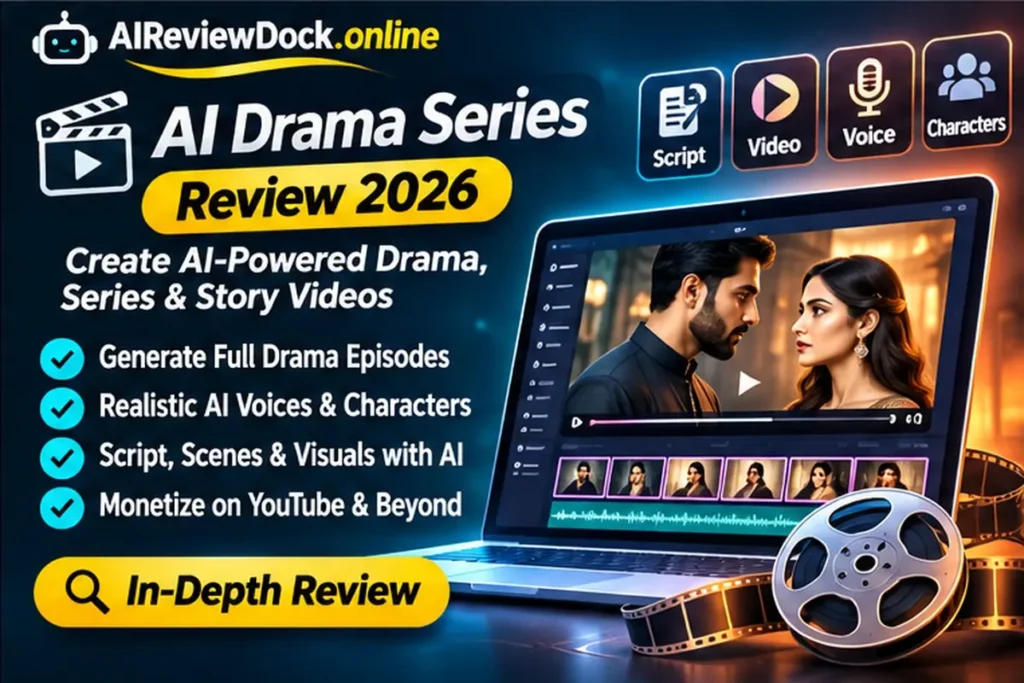
AI Drama Series review 2026: A connected fictional series needs consistent characters, useful dialogue, a logical storyline and legally usable footage. AI Drama Series, a LaunchPadJV product associated with Justin Opay, markets a cloud-based pipeline from one idea to several episodes with recurring characters, voice performances, music and captions. It launched October 24, 2026. Advertised launch discounts from October should not be assumed valid now.
This is a research-based buyer review, not a firsthand production benchmark. We have not purchased the software, generated episodes or independently verified claims about rendering speed and rights. Readers should judge the actual checkout, documented licenses, export options and a real multi-episode demonstration before making a production commitment.
Affiliate disclosure: Our four marked partner buttons may earn a commission if you buy. They do not guarantee revenue, views, consistent characters or a particular quality of output.
Check AI Drama Series Current Offer
AI Drama Series Review 2026: Product Overview
LaunchPad offer #600 describes an episodic storytelling product from Justin Opay. Public marketing mentions season planning, scene creation, voice acting and vertical or widescreen video delivery. Those are advertised features rather than independently measured performance results. The useful question is whether the account lets a creator edit and recover individual scenes without repeatedly paying for an entire new season.
9 Important Buyer Checks Before Paying
The most important areas are cast continuity, story logic, motion quality, synthetic voices, commercial licenses, credits, export restrictions, distribution policy and the full funnel cost. Each is examined below with practical tasks you can use to judge a vendor demonstration or a small pilot. Publishing an automated video without proper permissions or human review can create quality and legal problems.
1. Test character consistency across several episodes
Build two fictional characters with clear appearance, clothing and speaking styles, then ask for three episodes in different locations. Compare side-by-side frames rather than trusting the same character name in each prompt. A continuity feature should preserve facial proportions, hairstyle and recognizable mannerisms while allowing intentional wardrobe changes. Test close-ups, long shots and moving scenes; a still promotional screenshot cannot establish whether the system keeps identity consistent once characters turn their heads or interact with props.
Ask whether the editor stores an editable character bible, lets users supply authorized reference images and can repair one incorrect scene without discarding the rest of a season. Measure the number of retries before a character looks right. No vendor should promise flawless consistency without a representative multi-scene demonstration. For professional storytelling, a reusable reference workflow may matter more than the number of characters the marketing page says you can generate.
2. Evaluate the season outline and script editing
A good serialized story has continuity of events, not only cliffhanger endings. Begin with a three-episode plot where a decision in the first episode creates a consequence in the second and leads to a different resolution in the third. Review whether characters remember information revealed earlier, whether relationships evolve consistently and whether dialogue sounds natural instead of repeating generic dramatic phrases. The generator should organize information in a way a writer can inspect rather than hiding the plot behind an automatic render button.
Test a small revision: change the last scene of episode two without overwriting episode one or the opening of episode three. If the system cannot maintain a story bible or export editable scripts, long projects become fragile. Save human-approved outlines as separate files and keep a record of changes. A sensible workflow lets an editor approve scripts before expensive video generation begins, because correcting a weak storyline after rendering may consume significantly more credits and time.
3. Inspect actual motion and scene quality
Look beyond high-quality promotional stills. Test an indoor conversation, a walking scene and a simple interaction where one character hands another a letter. Inspect movement, hand anatomy, lighting, object continuity, background geography and whether the camera follows the action properly. Generated videos can look convincing for a second but drift when objects move or characters interact. Ask for unedited exports at the actual resolution included in the purchased plan, not just selected footage processed by another editing package.
Run the same scene prompt more than once and record how many results are usable. Check render time, unexpected watermarks, distorted subtitles and whether there is an option to trim or replace one faulty shot. A creator who spends an hour repairing each generated minute may not save production time, even if the initial clip takes only a few clicks. The practical measure is usable scene quality per unit of editing and generation cost, not the number of impressive model names advertised.
4. Check voice acting, lip sync and permission
Use a conversation between two fictional characters that includes longer sentences, names, pauses and a change of emotion. Listen for pronunciation, stable accents, consistent voices and whether the mouth movements match spoken words. Check if the platform can edit speech and subtitles independently, as small timing mistakes can make dramatic scenes difficult to watch. Find out which engine supplies synthetic voices and whether premium voices, translation or longer dialogue use additional credits or a separate subscription.
A technical option to reproduce a real voice does not automatically provide permission to use it in a commercial story. Avoid cloning an identifiable performer without authorization and consider rights of publicity, impersonation and contractual obligations. Our AI voice-cloning consent and rights guide explains these distinctions. Keep written permission for real-person inputs and choose approved fictional voices when testing. Better voice quality is not useful if its use creates an unresolved legal problem.
5. Confirm music, visual asset and copyright rights
A drama series can contain voice performances, generated backgrounds, stock effects, written scripts and a soundtrack. Each asset may involve a different permission or license. Ask whether music is original to the app, generated by a third-party service or sourced from a catalog, and whether the exact package permits commercial publication and client redistribution. A badge saying full commercial rights does not establish exclusive ownership of every component. Preserve receipts, source files and relevant license documents so a future content dispute can be investigated.
The U.S. Copyright Office AI resources explain how human creative contributions and AI output raise different questions. Our AI image copyright guide examines the distinction between commercial permission and exclusive protection. Test with original fictional stories and non-infringing reference material. If you intend to sell a complete season to a client, ask whether the license authorizes sublicensing music, images, voices and scene files rather than just posting a finished video on your personal channel.
Check AI Drama Series Licensing and Included Features
6. Estimate credits, rendering limits and failed attempts
Cloud video generation consumes compute even when the launch describes one-time or lifetime access. Check exact scene and episode limits, rendering duration, quality tiers, credits per minute and whether an unsuccessful attempt uses the allowance. Compare basic and upgraded editions for model availability, project storage, simultaneous jobs and daily caps. Ask whether unused credits roll over and what happens if an upstream AI provider changes pricing or discontinues a model after you purchase.
Create a realistic cost estimate: twelve sixty-second episodes, several retakes per episode, two export formats, thumbnails and captions. For each step, ask whether the front-end plan covers the work or requires an add-on. A product described as unlimited may still have fair-use provisions. The buyer should also check project backup and recovery, since the cost of losing a half-completed season can outweigh the license price. Begin with a low-risk pilot before promising production capacity to a client.
7. Verify video export options and disclosure obligations
A vertical 9:16 clip may need a different camera composition from a widescreen 16:9 video; cropping is not always sufficient. Confirm actual file resolution, codec, caption options, watermarks, audio quality and maximum export duration under the plan. Look for a way to edit source scenes outside the app and replace a single incorrect shot. If each aspect ratio requires a completely new render, that could increase time and credits. Test both formats using a dialogue scene with characters at opposite edges of the frame.
YouTube publishes guidance about altered or synthetic content disclosure. Creators should determine whether realistic synthetic scenes need a label on their destination platform. Disclosure does not grant copyright permission, and publishing through a compliant upload interface does not guarantee eligibility for advertising revenue. Check the policies for impersonation, reused material, music and content involving minors whenever relevant. The editorial review should happen before the work goes public.
8. Evaluate realistic audience value and production time
A product may create many episodes rapidly, but viewers decide whether the story is worth watching. Plot quality, memorable characters, pacing, editing, subtitles and thumbnails matter as much as render speed. Track the number of corrections required before each episode is ready. A promotional claim about millions of views or passive income is not a forecast. Revenue from video platforms depends on eligibility, geography, engagement, rules and changing advertising markets, none of which a generator can guarantee.
Use a quality scorecard for three pilot episodes: coherent story, character consistency, clear audio, readable captions, usable exports and legal rights. Ask a small audience for feedback on the story rather than only the technical appearance. If your team spends more time fixing inconsistent scenes than it would making simpler videos, the product may not fit the project. Publishing fewer carefully edited installments can be a better strategy than producing a large series that adds little original value.
9. Check the current offer, upsells, refunds and support
Third-party promotional pages from October describe a low entry price and optional one-time offers. Some advertised coupons were connected to the late-October launch period and may be expired by November 4. At the current checkout, confirm the merchant name, exact payable amount, payment fees, taxes and which capabilities are included. Determine whether agency rights, longer series, commercial models or extra rendering capacity require additional purchases. Do not treat a regular-price comparison on the sales page as independently verified savings.
Review the written refund deadline, eligibility criteria, support contact and account cancellation process. Ask how long the vendor stores finished videos, whether you can export scripts and assets, and what happens when an upstream video or voice provider changes. A lifetime access promise is not a guarantee that cloud servers and third-party APIs remain unchanged forever. An agency should get written confirmation of client use and retain receipts, permissions and the current contract before taking paid work.
Production, Rights and Pricing Analysis
The buyer should choose a fictional three-episode pilot, document each scene rendered and check the final licensing terms. A low front-end purchase price does not remove the cost of failed attempts or guarantee that future AI-model access will remain unchanged. October launch promotions are historical references; the only reliable price is the actual total displayed on the seller checkout.
How AI Drama Series Compares with Other Video Workflows
A general AI video generator normally focuses on individual clips and their visual quality. A music-video tool emphasizes lyrics, beats and matching visuals. AI Drama Series is positioned differently: it tries to keep the same fictional cast and storyline across multiple related episodes. These categories overlap, but their strongest evaluation criteria are not identical. Character continuity and editable season arcs matter for an episodic drama; synchronization matters more for a song. Avoid choosing the most elaborate tool when your project only needs one short video ad.
For related buyer checks, see our AI VideoSongs review for synthetic singing, music licensing and costs, and the VideoHub AI review for generation credits, editing and the limits of unlimited-video marketing. Those articles are independent research frameworks rather than a claim of a side-by-side controlled benchmark across all three products.
A Seven-Day Pilot Before Producing a Full Season
| Day | Small test | What to record |
|---|---|---|
| 1 | Write three linked fictional episodes | Plot consistency and editable outline |
| 2 | Create two fictional recurring characters | Reference control and permissions |
| 3 | Render a conversation and action scene | Motion stability and character appearance |
| 4 | Generate voices and captions | Timing, pronunciation and available rights |
| 5 | Revise one scene | Credit consumption and whether other scenes persist |
| 6 | Export vertical and horizontal video | Watermark, resolution and outside editing |
| 7 | Review costs and publication rules | Usable output, permissions and support experience |
This test can be completed privately; it does not need a public channel or a real person’s likeness. Keep the scripts and a simple log of each completed or failed generation. One important question is whether a good outcome survives normal revisions. A creator can always select an impressive frame from ten poor attempts, so report both usable results and the effort needed to achieve them. When reporting to a client, be explicit about what was produced with AI and what was edited or written by humans.
Price and Total Cost: What to Confirm
Historical October 2026 promotional reviews described an entry offer near $17 and a large series of optional upsells, but these are not confirmed current prices on November 4. Do not publish an expired coupon as an active saving. Ask whether a purchased tier includes episode counts, reference storage, rendering minutes, higher-quality models, commercial publishing, agency use and access to exported files. Total cost should include failed renders, voice and music permissions, manual editing and any recurring services involved. A small test is the safest way to know what a production of your desired length actually requires.
View AI Drama Series Live Plans and Upgrade Terms
For a freelancer planning regular productions, costs compound with revisions. A quoted per-season price should include realistic retries and final client changes. For a hobby creator, a limited entry tier may be entirely sufficient. Neither buyer should infer that an unlimited label means unrestricted advanced model calls. Ask the seller to confirm what happens when account access ends, whether scripts and videos remain downloadable and whether licenses cover public distribution long after the original promotion.
Frequently Asked Questions
The main buyer questions are whether the tool creates a coherent story, whether each episode preserves identities, what can be published commercially, and how many retries or exports are included. Those answers require the actual product edition and its terms, not just a promotional trailer.
Can AI Drama Series produce a whole season from a single idea?
This is the headline vendor claim, but a useful season still requires an editable outline, coherent dialogue and quality checks. The actual number of usable episodes depends on rendering limits, revisions, prompt complexity and rights. Ask to inspect three unedited consecutive exported episodes before committing to a large project.
Will the same character’s face and voice remain stable?
The seller markets character continuity; we have not independently established a failure rate. Test close-ups, movement and emotional changes across scenes, then compare the exact exported frames. A promotional trailer may show only the best results.
Does buying AI Drama Series guarantee YouTube monetization?
No. Monetization is subject to platform eligibility, originality, licensing, advertiser policies, audience engagement and other conditions. A generator cannot promise channel revenue, even if it can technically export videos suitable for upload.
Are October 2026 discount coupons still working?
Not confirmed. Promotional offers from the October 24 launch may have expired. The price and terms shown at your actual checkout should control the decision, including optional upgrades and fees.
Can I use the product for paid client videos?
Only when the exact purchased license permits client work and you possess the necessary rights for all music, voices, characters and images. Keep a record of the license and the client’s approved creative brief.
Can I use real celebrities or clone their voices?
Do not do so without appropriate authorization. Technical generation capabilities do not remove privacy, publicity, intellectual-property or impersonation rules. Use fictional characters in initial demonstrations.
Do I have to buy all the upsells?
No. Determine the features needed for your pilot and check what the base license actually includes. Buy a specific upgrade only after you identify a real limit in your production requirements.
Did AI Review Dock perform a hands-on test?
No. This article is based on available product descriptions and a practical testing framework, not a report from an independently operated paid account.
Check AI Drama Series Current Checkout and Refund Rules
Final Verdict
AI Drama Series is worth evaluating as a workflow for creating serialized fictional video, not as a promise of automated profits. Verify a small project, edit the scripts, check copyright and synthetic-content policies, and understand the plan limits before expanding. Editorial review: November 4, 2026.