
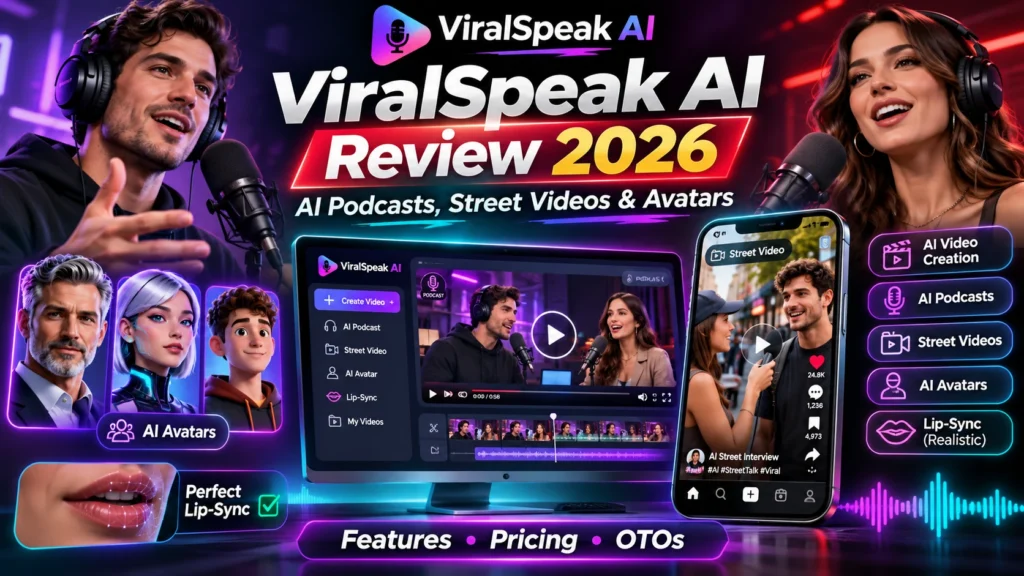
ViralSpeak AI review 2026 — ViralSpeak AI is a cloud video product marketed for four kinds of talking content: simulated street interviews, AI two-person podcasts, stand-up clips and synthetic talking avatars. The vendor’s November 13, 2026 JV page advertises natural voices, synchronized lips, script generation and MP4 output with commercial usage claims. Yet the same launch has a complex eight-upgrade funnel and conflicting front-end figures across public listings. This review explains what a buyer should verify before publishing staged interviews or synthetic conversations that could be mistaken for real people.
Editorial disclosure: Research compiled November 13, 2026 from launch pages and public material. We have not purchased the software, verified claimed speed or measured profits. The four buttons below point to untracked public information, not approved affiliate URLs.
ViralSpeak AI: quick facts and buyer verdict
| Fact | Current evidence |
|---|---|
| Seller | Rudy Rudra |
| Marketplace | Launchpad; launch November 13, 2026 |
| Front-end price | JV page shows $17; other launch listings around $14.95 |
| Creative types | Street interviews, two-person podcasts, stand-up, talking avatars |
| Commercial rights | Promoted by seller; exact client and resale terms require checking |
| Upgrade funnel | Vendor lists OTO1 through OTO8 |
| Testing disclosure | No paid-account export, voice or timing benchmark performed |
Why this matters: ViralSpeak AI has a distinct content mix, but realistic synthetic interviews introduce trust and disclosure risks. Consider it only after checking a real MP4 export, quota and licensing restrictions, and the entire eight-OTO funnel. It is not a shortcut to guaranteed viral traffic.
What ViralSpeak AI does — and what it does not prove
ViralSpeak AI is a cloud video product marketed for four kinds of talking content: simulated street interviews, AI two-person podcasts, stand-up clips and synthetic talking avatars. The vendor’s November 13, 2026 JV page advertises natural voices, synchronized lips, script generation and MP4 output with commercial usage claims. Yet the same launch has a complex eight-upgrade funnel and conflicting front-end figures across public listings. This review explains what a buyer should verify before publishing staged interviews or synthetic conversations that could be mistaken for real people. The most important distinction is between a seller’s capability claim and the actual output a buyer can independently inspect. A product is valuable only when it addresses a specific task with acceptable cost, quality, privacy and support.
ViralSpeak AI: detailed feature analysis
1. Simulated street interviews
Street interview videos can communicate a survey-style joke or teach a concept, but they can also mislead viewers into believing actual people were interviewed. Make the fictional, AI-generated nature evident in the video and accompanying caption.
The practical test is whether this capability works in an ordinary customer scenario, not only in a promotional example. Retain a baseline, compare deliverables and document what the account actually allows.
2. Two-person synthetic podcasts
A second speaker introduces interruptions, changing voices and difficult lip-sync timing. Test several overlapping responses rather than accepting a single smooth clip as proof that a full conversation will remain coherent.
The practical test is whether this capability works in an ordinary customer scenario, not only in a promotional example. Retain a baseline, compare deliverables and document what the account actually allows.
3. AI stand-up comedy shorts
The vendor advertises joke drafting and performed delivery. Quality depends on timing, tone, audience suitability and originality. Avoid copying a living comedian’s unmistakable voice or making a real person appear to endorse offensive material.
The practical test is whether this capability works in an ordinary customer scenario, not only in a promotional example. Retain a baseline, compare deliverables and document what the account actually allows.
4. Talking avatars and lip sync
The system claims a range of synthetic faces, ages and styles with multi-speaker mouth synchronization. An acceptable output must preserve identity across shots and avoid unconsented imitation of recognizable private individuals.
The practical test is whether this capability works in an ordinary customer scenario, not only in a promotional example. Retain a baseline, compare deliverables and document what the account actually allows.
5. Automated script and voice generation
Given one keyword, the vendor says the application writes dialogue and speaks it using AI voices. Before posting, confirm script accuracy, pronunciation, language coverage, acceptable-use policies and the actual narration license.
The practical test is whether this capability works in an ordinary customer scenario, not only in a promotional example. Retain a baseline, compare deliverables and document what the account actually allows.
6. Short-form MP4 export
The product is aimed at Shorts, Reels, TikTok and Facebook. Test the downloadable file on multiple devices, read the subtitles at phone size and verify that the export does not have unexpected branding, aspect cropping or compressed audio.
The practical test is whether this capability works in an ordinary customer scenario, not only in a promotional example. Retain a baseline, compare deliverables and document what the account actually allows.
7. Commercial licensing and upgrade limits
Seller material advertises a commercial license in the front end and many upsells including an Agency/Reseller/Whitelabel ladder. Those terms are not interchangeable: delivering a video to a client differs from reselling the application itself.
The practical test is whether this capability works in an ordinary customer scenario, not only in a promotional example. Retain a baseline, compare deliverables and document what the account actually allows.
ViralSpeak AI: step-by-step independent evaluation
These instructions describe what a purchaser should test; they are not claims that our editorial team has completed paid testing. Use authorized materials and choose a small reversible test.
Step 1: Choose a transparently fictional idea
Select an educational topic or obviously dramatized comedy scenario. Avoid a premise that invents a real-world news interview or impersonates a named public figure.
Step 2: Write a short script before generation
Specify two speakers, twenty to forty seconds of dialogue and accurate facts. Edit the outline so each speaker contributes a different thought.
Step 3: Generate a test street scene
Check that avatars and background look consistent and that the scene is unmistakably labeled synthetic if needed.
Step 4: Check mouth synchronization frame by frame
Compare the audio with the visible speech during name pronunciations, number-heavy lines and pauses.
Step 5: Check the output’s visual and sound quality
Review the MP4 at 9:16 resolution, verify captions, check music licensing and watch on a slower phone.
Step 6: Write the platform disclosure
Add the relevant labels for altered or synthetic content, especially realistic voices and apparent interviews.
Step 7: Measure real cost and audience value
Record generation speed, allowed export count, quota restrictions, paid upgrades and editing time. Judge engagement on honest educational usefulness, not promises of virality.
ViralSpeak AI pricing, OTOs and total ownership cost
Product launches often display one entry amount prominently and other plans only after checkout. Do not assume every advertised scene, report, export or commercial right is bundled into the entry offer. The table separates source-based prices from still-unverified feature inclusions.
| Plan / tier | Public listing | What to confirm |
|---|---|---|
| Front-end offer | $17 on seller JV page | Launch calendar elsewhere lists $14.95; verify live checkout. |
| OTO1 | $47 on JV funnel | Upgrade contents require checking. |
| OTO2 | $97 | Confirm user quota and feature scope. |
| OTO3 | $67 | Check deliverables and credits. |
| OTO4 | $197 | Verify whether part of agency rights. |
| OTO5 | $297 | Check licensing and client/seat limits. |
| OTO6 | $147 | Separate upgrade; scope not confirmed. |
| OTO7 | $67 | Separate upgrade; scope not confirmed. |
| OTO8 | $297 | Separate upgrade; scope not confirmed. |
A fair cost comparison includes renewal terms, processing limits, third-party API fees, exports, agency permissions, refund exclusions and editing time. Vendor revenue claims, contest winnings and promotional conversion figures are not evidence that an ordinary customer will earn a return.
ViralSpeak AI: nine buyer risks and how to mitigate them
1. Misleading realism
People may mistake staged interviews and podcasts for real recordings. Label synthetic scenes and do not fabricate testimonials or interviews. Ask the vendor for the specific line in their current terms and save a copy before committing to a paid plan.
2. Voice and likeness consent
Avoid a recognizable person’s voice or likeness unless you have appropriate permission; the software license does not grant third-party identity rights. Ask the vendor for the specific line in their current terms and save a copy before committing to a paid plan.
3. Numerous optional upsells
Eight OTOs can make the real acquisition cost far greater than the front-end sticker price. Ask the vendor for the specific line in their current terms and save a copy before committing to a paid plan.
4. Conflicting entry amounts
The seller’s JV page shows $17, while listings show about $14.95. Current checkout determines the actual rate. Ask the vendor for the specific line in their current terms and save a copy before committing to a paid plan.
5. Unverified output speed
Claims such as under ninety seconds are vendor marketing; latency and quality may vary by project. Ask the vendor for the specific line in their current terms and save a copy before committing to a paid plan.
6. Platform monetization
No video tool guarantees Shorts views, ad monetization or client payments. Ask the vendor for the specific line in their current terms and save a copy before committing to a paid plan.
7. Commercial license scope
Check whether the core license covers paid client delivery, resale, teams and any white-label activity. Ask the vendor for the specific line in their current terms and save a copy before committing to a paid plan.
8. Music and asset rights
Inspect soundtrack, stock imagery, subtitles and templates for licensing and third-party restrictions. Ask the vendor for the specific line in their current terms and save a copy before committing to a paid plan.
9. Refund and support
The vendor advertises a 30-day guarantee. Review marketplace policy, upgrade exclusions and seller responsiveness. Ask the vendor for the specific line in their current terms and save a copy before committing to a paid plan.
Three realistic use cases for ViralSpeak AI
Educational street-interview sketch
Two fictional presenters debate a study tip. The video should clearly explain that the interview is staged and invite the viewer to learn more from a credible source.
Creator’s two-host podcast teaser
Write an original thirty-second exchange, with no impersonation and a clear disclosure. Measure whether speech and mouth movements remain synchronized before scaling to longer episodes.
Local business training clip
A fictional customer asks how a service appointment works; a synthetic employee explains the verified steps. Do not imply actual reviews or testimonials from real buyers.
ViralSpeak AI: pros, cons and recommended buyer
| Possible advantage | Important limitation |
|---|---|
| Simulated street interviews | People may mistake staged interviews and podcasts for real recordings. Label synthetic scenes and do not fabricate testimonials or interviews. |
| AI stand-up comedy shorts | Eight OTOs can make the real acquisition cost far greater than the front-end sticker price. |
| Talking avatars and lip sync | The seller’s JV page shows $17, while listings show about $14.95. Current checkout determines the actual rate. |
| Dedicated workflow rather than broad generic generation | Performance and value have not been independently benchmarked. |
The strongest fit is a buyer with a narrow, well-defined workflow, permission to use their source material and time to inspect final output. Skip the purchase when you need guarantees of traffic, sales, safety, or a feature that belongs only to a costly reseller plan.
Alternatives and related technical guidance
For adjacent products already reviewed by AIReviewDock.online, compare AutoCinema AI review and VidZonic AI review. Choose on actual workflows and licenses rather than the number of bullet points on a sales page.
Longer-running educational guidance lives separately on AIReviewDock.com: YouTube AI video disclosure requirements and AI voice and likeness consent guide. These explain the underlying principles beyond any one launch.
ViralSpeak AI: frequently asked questions
Is ViralSpeak AI a real street-interview recorder?
No. The vendor markets AI-generated virtual presenters and synthetic interview scenes, not footage of actual interviews.
How much does ViralSpeak AI cost?
Vendor JV material lists a $17 entry and eight optional upsells. External listings sometimes show about $14.95. Check the current purchase page.
Can I sell videos to clients?
Commercial rights are advertised but agency, reseller and white-label permissions have separate terms. Read the selected license carefully.
Are all video outputs unlimited?
Unlimited generation appears in seller language, but actual account limits and upsell rules must be verified.
Does it guarantee viral YouTube traffic?
No. Audience interest depends on writing, production, original value and distribution.
Do synthetic podcasts need labeling?
For realistic fabricated scenes, use appropriate platform disclosures and do not misrepresent identities or factual events.
ViralSpeak AI review 2026: evaluate output quality with a practical scorecard
The four promoted formats—street interviews, two-host podcasts, stand-up clips and talking avatars—should be tested differently. A humorous talking-head video can tolerate a simpler backdrop; a simulated interview requires explicit disclosure and should not appear to document real testimony. The table below describes a repeatable evaluation rubric, not our own measured result from the product.
| Criteria | Pass condition | Common failure |
|---|---|---|
| Identity consistency | Same fictional characters across cuts | Unexpected face or clothing changes |
| Voice quality | Names, numbers and pauses spoken correctly | Mispronunciations or drifting accent |
| Lip synchronization | Visible mouth roughly follows each speaker | Delayed or wrong character lip movements |
| Script originality | Original, coherent dialogue with factual checks | Copying another creator’s interview |
| Short-form export | Legible, stable vertical MP4 | Cropping, watermark or unreadable captions |
| Permissions | Licensed, consented and clearly synthetic | Unauthorized celebrity imitation |
| Cost per usable clip | Actual charges including rejected renders | Focusing on the $17 front end only |
Four example prompts that avoid fake real-world interviews
- Street scene: Two visibly fictional animated presenters discuss a recycling myth and label the exchange as a scripted AI reenactment.
- Podcast scene: A clearly synthetic science teacher and student discuss why a graph can be misleading, with references verified before publishing.
- Comedy clip: An original fictional character delivers a short workplace joke without copying a recognizable comedian’s voice or signature performance.
- Business explainer: A synthetic support agent outlines an appointment process using real approved company policies, with no fabricated customer testimonial.
Keep the first project to 20–40 seconds. Export it, check the result on a phone, and document total credits or limits used. Only expand to longer episodes after evaluating character continuity, captions and audio behavior. The vendor’s sub-90-second rendering claim remains marketing material until tested under the buyer’s actual account.
ViralSpeak AI upsell arithmetic and license checklist
The JV page advertises an initial $17 price followed by eight upsells priced $47, $97, $67, $197, $297, $147, $67 and $297. Buying every listed item could total $1,233 including the front end, before taxes or provider charges. This is the sum of published figures and not an actual verified checkout transaction. A new creator should not assume every upsell is necessary or that all are sold at once.
| Scenario | Advertised cash cost | Permission to verify |
|---|---|---|
| Core test only | $17 front end | Generation limits and exported-client rights |
| Core + OTO1 | $64 combined | What extra capability the $47 upgrade adds |
| Core + Agency-like package | Unknown exact combination | Client work, seats and transfer of outputs |
| Every listed OTO | $1,233 total | Bundle overlap, credit caps and refunds |
Commercial use does not automatically include reseller or white-label rights, and a resale license does not grant permission to imitate a real person’s voice or face. Ask for written, tier-specific clarification before using generated clips in an agency offering. The same principle applies to music, effects and templates downloaded with the video.
ViralSpeak AI review 2026: transparent publishing and platform rules
Realistic synthetic street interviews can easily be confused with real-world footage. Do not represent AI-generated speakers as random people interviewed on a street, or claim that any real individual approved a product. Where platform disclosure options apply, use them. Include a short visible context label such as ‘Scripted AI demonstration’ when confusion is likely.
The distinction matters commercially. Viewers who discover a supposedly genuine testimonial is synthetic may lose confidence in the creator. Honest scenario labels may be less sensational, but they protect long-term credibility. Likewise, a content tool cannot guarantee platform monetization, audience size or paying clients.
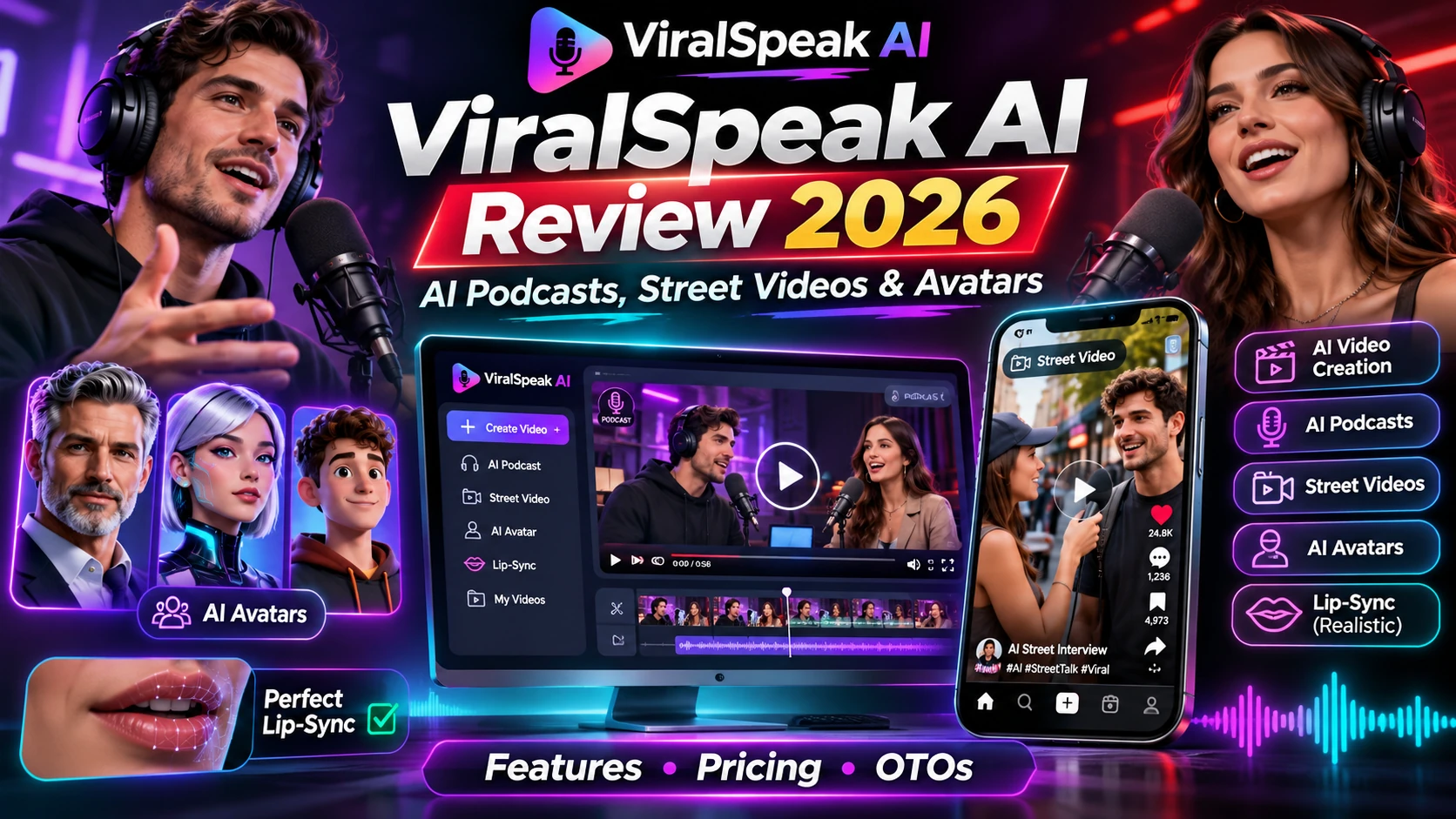
Featured artwork and what it means
The editorial graphic below is a conceptual mock-up of talking-video features. It is not a screenshot from a paid ViralSpeak account or proof of viral performance.
ViralSpeak AI compared with editing your own talking videos
A normal editor plus a licensed narration service may offer more control over pacing, creative direction and identity permissions. ViralSpeak’s advantage would be convenient end-to-end generation if the actual exported clips pass the scorecard. Compare editing time and export quality with an ordinary workflow before spending on agency, reseller or white-label tiers.
ViralSpeak AI: final recommendation
ViralSpeak AI has a distinct content mix, but realistic synthetic interviews introduce trust and disclosure risks. Consider it only after checking a real MP4 export, quota and licensing restrictions, and the entire eight-OTO funnel. It is not a shortcut to guaranteed viral traffic.
Avoid using launch countdowns to decide faster than the facts justify. Review current pricing, refund terms, permitted marketing methods, data use and sample deliverables before committing.
Sources, corrections and methodology
Sources checked November 13, 2026: product or JV offer information and YouTube disclosure guidance for AI-generated content. All claims about the software’s features, speed and inclusions remain attributed to vendors or launch coverage until independently tested.