
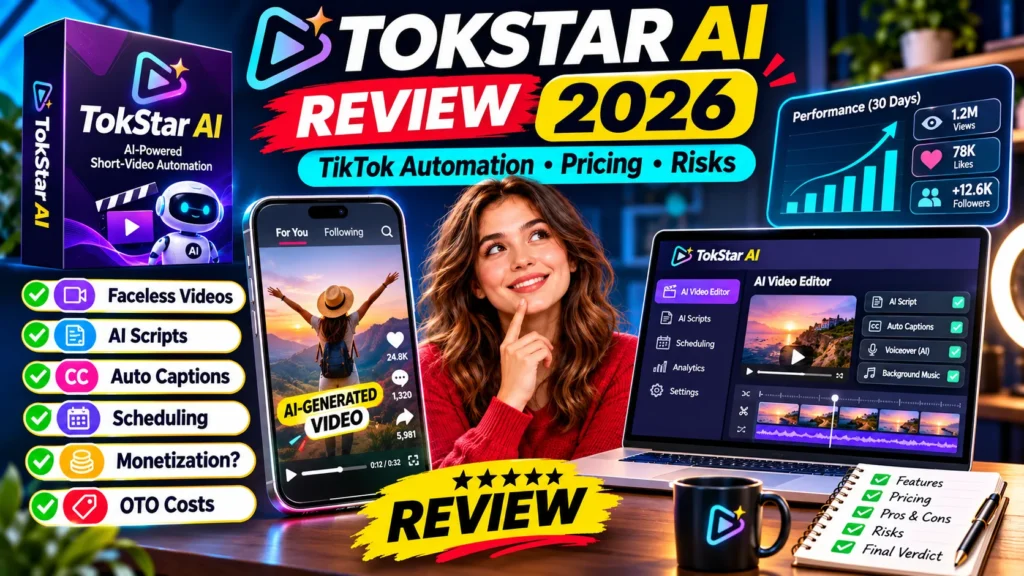
Affiliate disclosure: AI Review Dock may receive a commission through links in this review without changing your price. We have not personally tested TokStar AI; vendor claims are distinguished from verified policies and buyer considerations.
TokStar AI Review 2026: Quality Before Automation
A useful TokStar AI review should judge how many generated clips are genuinely worth publishing. Producing a high volume of short videos is not the same as building a channel that people trust. An effective clip answers a real viewer question, communicates with clear pacing, and delivers a useful conclusion. The software may save editing time, but the creator still owns factual accuracy, originality and the account’s reputation.
Start with a defined niche such as home cooking, language practice or small-business software tips. Choose three common questions from real audience feedback. Create a short explanatory video for each, then check whether the visuals demonstrate the point being made. If captions obscure the scene, the speaker mispronounces a key term, or the advice is wrong, log the correction time. A clean, branded, accurate video matters more than a high generation counter.
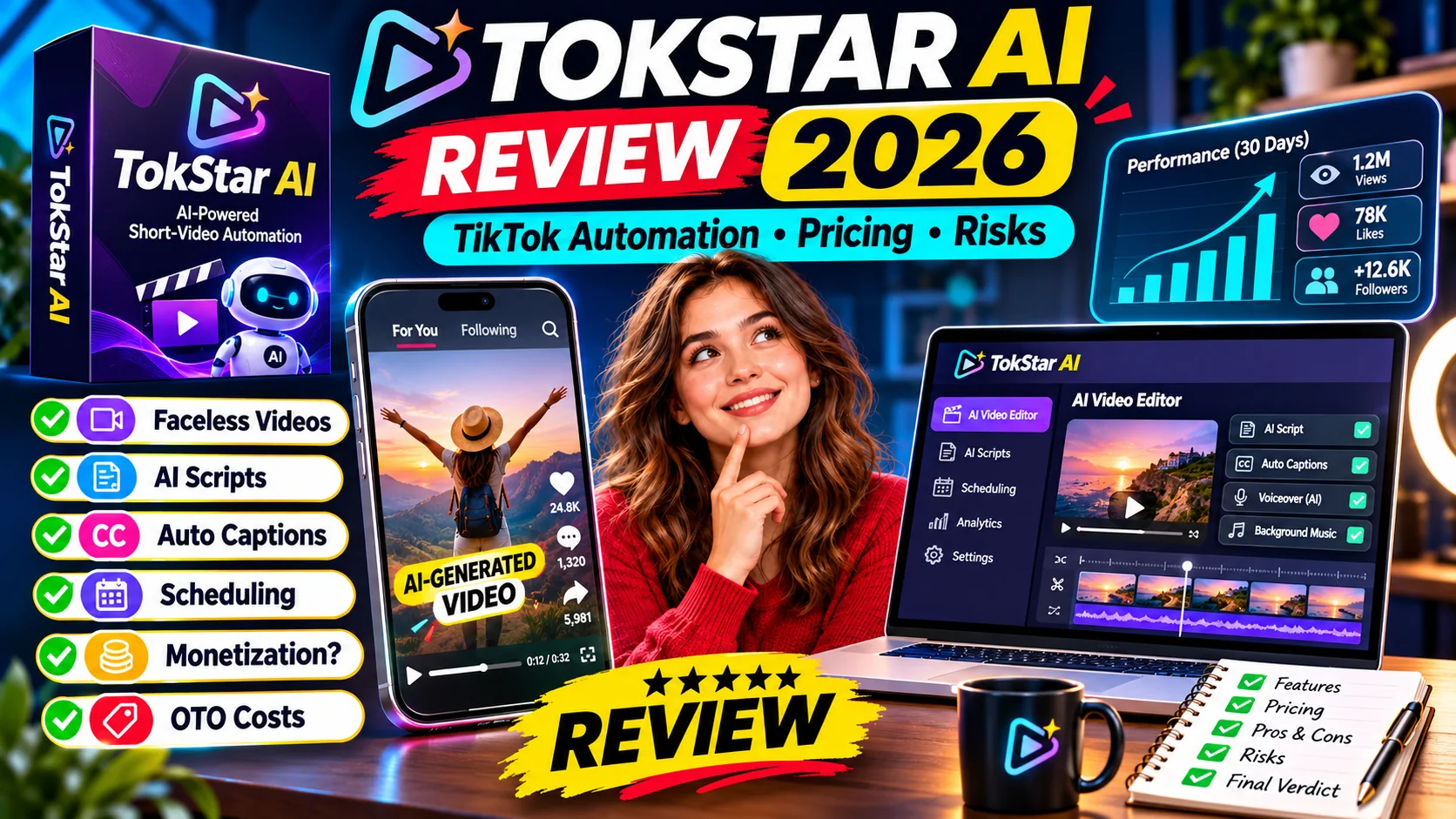
How to evaluate publishing automation
A scheduler should support drafts, previews, explicit approval and failed-post notifications. Ask whether account permissions use an official authorization flow and whether access can be revoked. A request for a primary social-media password is a reason to investigate security more closely. A TokStar AI review should separate generating an MP4 file from having permission to publish it through a platform integration.
For synthetic media, review the network’s current labeling rules and the licenses for music, voices, visuals and source clips. A generated video does not acquire commercial rights simply because it contains AI-created elements. Do not use a cloned person’s likeness or voice without appropriate rights and consent. If the channel covers sensitive issues, create a stronger human review process before posting.
A cost-per-approved-video calculation
Imagine creating twenty clips. Twelve require substantial fixes, five are rejected, and only three are accepted with minor edits. If editing the successful clips and reviewing the others takes six hours, the production cost includes those six hours as well as the software purchase. This is a hypothetical scenario, not a result measured with TokStar AI. Tracking approved output and editing time is more valuable than believing launch-day claims of instantaneous content businesses.
Compare the tool against a manual video editor for your exact format. A creator with carefully scripted talking-head videos may gain little from automatic scenes; a creator who needs basic captioned explainers might save significant time. Keep fonts, narration style, caption placement and a recognizable visual identity consistent. Evaluate whether the app can save those settings between projects.
Finally, measure audience response rather than treating views as revenue. Comments, saves, repeat viewers and qualified clicks can reveal whether your format is working. TikTok reward-program participation and eligibility are separate questions that depend on platform rules and region. The TokStar AI review verdict is that automation may improve a sound editorial process but cannot invent one.
Buyer checklist: confirm export resolution, watermark terms, posting permissions, fair-use restrictions, soundtrack rights, current checkout price and optional edition limits. A serious TokStar AI review should make these trade-offs visible before recommending any purchase.
TokStar AI is marketed by Pranshu Gupta as a system for generating and managing TikTok-style videos with AI. Its LaunchPadJV release dates to November 5, 2026, and the sales pitch leans heavily on fast production, faceless content and automated channel growth. Those claims sound promising for creators who find video editing slow. The crucial distinction is that content creation, social distribution and earning money are three different businesses.
In this TokStar AI review, we look at what automation should actually deliver, how to test output quality, which parts of channel management require human oversight, and whether the advertised entry price covers a complete workflow. We have not used a paid TokStar account and are not claiming personal channel results. The assessment is based on the launch listing, publicly described features and platform requirements.
What the product is supposed to do
Public descriptions present a workflow that helps with video ideas, scripts, creative assembly, captions and some channel-management tasks. There may be templates for faceless formats and a publishing or scheduling component. Because marketing pages often group all editions together, buyers must confirm which actions work in the front-end license and which require upgrades.
A creator should request a complete demonstration: enter a niche topic, generate a script, assemble a video, adjust its scenes, export the result, connect an account if supported and observe how a posting failure is handled. A dashboard showing many videos is not enough evidence that each video is original, accurate or approved for distribution.
A practical question is how much of the creative process remains editable. If the story hook is weak, can you rewrite it? If a scene is irrelevant, can you replace only that clip? If subtitles are wrong, can you fix them without regenerating everything? Fine-grained editing often matters more than how quickly the initial render appears.
Check TokStar AI Official Offer
A realistic test for a faceless channel
Imagine creating a channel offering one-minute tips for home coffee brewing. A strong video should answer a specific question, demonstrate an observable technique, use relevant visuals, explain the result clearly and offer a useful takeaway. An automated clip that recycles general advice over unrelated footage might satisfy a video quota without being worth a viewer’s time.
Create three sample videos from the same brief: an explainer, a myth-busting example and a before-and-after demonstration. Compare the first two seconds, narration quality, factual correctness, subtitle placement, visual coherence and export speed. Write down every correction required. Then ask two people in the target audience which clip they would actually watch to the end.
Do not measure success purely in the number of clips produced. A more honest production metric is approved, usable videos divided by total outputs. If ten generations yield three usable videos and each requires half an hour of editing, the creator still has a real labor cost.
Does it really publish videos automatically?
There is a major difference between generating downloadable MP4 files, scheduling posts through supported integration and automatically controlling a TikTok account. Ask which of those steps TokStar actually supports. In particular, check whether it uses a supported authorization flow or asks for your password, and how you can revoke access.
If a scheduler is included, test drafts, preview approvals, time-zone handling, failed-upload notifications and account disconnections. A reliable system should not post unreviewed synthetic content while the owner is away. It also needs a clear record of what was published and what failed.
Fully automated engagement is a separate risk. Generic comments, artificial interactions and misleading responses can harm trust. A tool can help owners organize replies and research questions, but it should not impersonate real customers or guarantee that social algorithms will reward its activity.
TikTok labeling, originality and licensing
Synthetic video introduces policy questions. TikTok maintains official AI-generated-content guidance explaining labels and rules for material generated or significantly edited by AI. Creators should review the current instructions before posting photorealistic events, synthetic depictions of real people or cloned voices. A product’s ability to create a video does not establish that the video complies.
You must also check music, voice and stock footage licenses. A file offered inside an AI editor is not automatically cleared for every commercial use. Keep a record of source assets and rights, especially if your channel promotes products or accepts sponsored work.
TikTok monetization programs have distinct eligibility, originality and regional requirements. A faceless video is not, by itself, proof of eligibility. Conversely, an AI tool cannot promise that a particular view count will generate a particular income. Before basing a business plan on rewards, verify which programs are available to your account and what the content rules demand.
Price and OTOs: what is actually included?
Public launch coverage repeatedly cites approximately $17 for the entry offer. That is a reported promotional amount, not an independently verified final checkout price on November 19. The cost may change with coupons or the sales funnel. LaunchPadJV also lists the product as an available affiliate offer, but that fact does not confirm the full tier entitlements.
Several third-party reviews describe optional editions related to increased capacity, additional publishing functions, done-for-you assets, agency rights and reseller or white-label licensing. The price and names of upgrades vary by source. Buyers should examine the live checkout rather than rely on an old OTO chart.
Calculate cost per usable video rather than focusing on a nominal one-time fee. Include revisions, other AI services, premium music, platform management and your editing time. If a higher-tier purchase is necessary to export without branding or use client accounts, its cost belongs in your evaluation from the beginning.
How to judge whether the videos are good
View every sample on a phone. Check aspect ratio and whether captions overlap the controls. Test pronunciation, spelling and pacing. The most persuasive content puts its strongest evidence close to the start and makes each scene support the message rather than filling time with visual effects.
For advice channels, verify factual claims from credible sources. This matters particularly in health, money, legal and news-related topics. A tool can confidently generate inaccurate statements. Correcting those mistakes is the publisher’s responsibility, even if the software produced the narration automatically.
Compare at least three outputs for repetitive phrases, reused images and identical structure. A channel needs a distinctive point of view. If every customer receives similar clips, growth may be difficult despite a fast publishing process.
Advantages, limitations and the right audience
Potential benefits: faster idea generation, a repeatable content workflow, reduced editing overhead for simple formats and a more organized process for people who currently start every video from scratch. These benefits would be useful only when the software produces material worth publishing.
Important limitations: we have not independently tested the software or account integration; creative quality may fluctuate; media rights and usage caps require confirmation; and upsells can materially raise costs. Claims about passive earnings or viral reach should be treated as marketing, not forecasts.
TokStar may suit a creator with subject knowledge and a clearly defined audience who wants to reduce routine production work. It is less suitable for a newcomer expecting the tool to invent a business, bring followers and earn rewards unaided. Compare the format with our ViralSpeak AI review or the carousel-based StoryDeck review before choosing a workflow.
How TokStar compares with manual editing and other AI video workflows
A manual TikTok process might use a researched script, a phone recording, a video editor and a small library of licensed music. A specialized AI video generator may instead produce scenes from text while leaving scheduling to another app. TokStar positions itself around combining more of those steps. That integration can matter, but only when it preserves control over script accuracy, timing and account permissions.
Perform a side-by-side comparison using the same topic and production requirements. Record how long it takes to make a finished 45-second explainer manually, through a general video generator and through TokStar. Count subtitles corrected, scenes replaced and licenses checked. Do not compare the time required to press Generate in one tool with the time required to deliver a publishable video in another. Both workflows should be judged at the same endpoint: a video ready for human approval.
It is also useful to consider the cost of maintaining a recognizable style. A channel may need repeated caption fonts, logo placement, presenter voice, disclaimers, intro pacing and a clear color palette. Ask whether TokStar can preserve a reusable brand kit and export editable projects. If you must repeatedly rebuild those details in an external editor, a cheap generation tool may offer less benefit than expected.
Metrics that matter more than production quantity
The most meaningful measures are qualified video output, average editing time per approved clip, retention from relevant viewers and repeat visits to your profile. View counts can be affected by a single trend or an unusually broad audience. A smaller video that generates genuine questions from potential customers might be more valuable to a business than one with many uninterested views.
For clients, track the intended commercial action as well: website visits, enquiries, sign-ups or purchases where measurable. Distinguish organic response from paid promotion. If the platform promotes income projections or automatic monetization, ask whether those figures refer to actual independently verified customers or hypothetical marketing examples. Without clear evidence, do not use a projected earnings dashboard as the reason to buy.
A seven-day mini experiment
- Choose a niche and three specific questions that real viewers ask.
- Generate three scripts and fact-check each one.
- Produce one complete vertical video and record every edit.
- Review copyright, AI labels and account-permission settings.
- Publish only content you have personally approved.
- Track audience retention and comments as well as views.
- Calculate the time saved and whether a paid upgrade is necessary.
A seven-day experiment is not enough to prove sustainable channel growth, but it will reveal whether the production system works for your actual videos. The goal is to collect evidence instead of trusting a dashboard’s estimate of how much money a channel could make.
Questions buyers often ask
Can TokStar guarantee viral views?
No. TikTok’s recommendation system is outside the vendor’s control.
Does the $17 plan include unlimited posting?
The public entry price is a launch claim; the exact posting, generation and export limits must be confirmed with the vendor.
Can I use generated clips commercially?
Only after checking the license for voices, music, video elements and the intended use.
Is human review still necessary?
Yes. Accuracy, originality, messaging, account security and policy compliance remain your responsibility.
Final verdict
TokStar AI could help creators streamline a repetitive production workflow. Its value is not how many videos it says it can create but how often it helps produce a strong, original clip with less effort. Buyers should verify video exports, publishing integration, OTO entitlements and rights before paying.
Our assessment is cautious because we have not independently operated a paid account. For a creator who already understands the audience and keeps control of publishing, the software may warrant a small trial. As a promise of hands-free income, the evidence available is not sufficient.