Affiliate disclosure: This article may contain affiliate links. If you buy through a link, AI Review Dock may earn a commission without increasing your price. This is a research-based assessment, not a hands-on test. Product capabilities, prices, and checkout terms should be checked directly before purchasing.
GPTHub AI review 2026 — quick verdict: A unified model dashboard may simplify routine work, but a branded model selector does not prove official access or an unlimited license. Compare documented model identifiers, provider terms, usage quotas, storage and optional API-key costs. Buy only when the specific tasks you need work in a controlled demo.
GPTHub AI is a 2026 LaunchPad offer associated with Anirudh Baavra and Amit Gaikwad. It is pitched as a central browser dashboard for multiple GPT-branded models and related creative workflows. The idea appeals to people who want a single interface for prompts, content planning, model comparison, and image work. However, an attractive ‘all GPT models’ offer raises an important technical question: is the system providing documented access to real provider model endpoints, or simply using those names as marketing labels?
This GPTHub AI review focuses on how to assess that question, what a lifetime purchase should include, and where hidden operating costs could emerge. We have checked the listed launch and third-party coverage; we have not received an independent GPTHub test account. All functionality discussed below is therefore treated as advertised until validated.

The Product’s Core Proposition
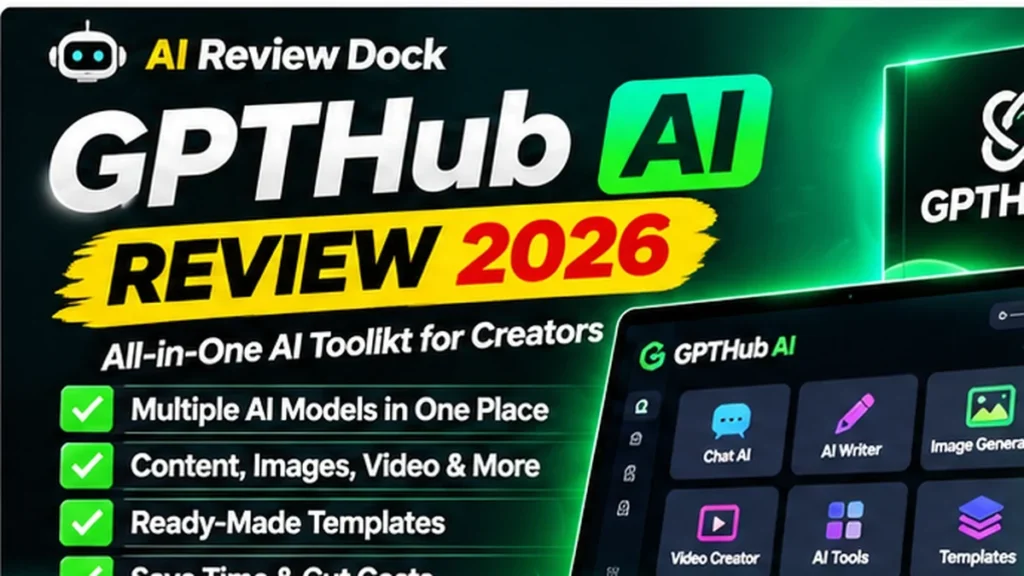
According to its launch materials, GPTHub AI places model selection and common AI tasks inside one dashboard. Descriptions mention a model switcher, prompt library, comparisons and image generation. That could be useful if the account provides consistent prompt history, clear controls and understandable usage reporting. But feature lists are not proof that each feature works as advertised or is included in the basic license.
The most important distinction is between a workflow wrapper and the models running underneath. Many apps use official APIs to offer a simpler interface; others use their own model services or third-party resellers. Buyers should know which arrangement applies here, how content is processed, and whether their messages are sent to outside providers.
How to Verify the Claimed GPT Models
The product promotion names specific GPT versions. These labels are claims by the seller, not verification by the underlying model provider. A reliable seller should identify exact model endpoint names, update policies, feature limitations, and whether requests are routed through an official API. If model names are presented that you cannot corroborate in provider documentation, seek clarification before purchasing.
Run a reproducible test set: generate a precise JSON object; compare answers to the same five factual prompts; evaluate a technical reasoning example; try a long text input; and test whether the chosen model’s advertised context or tools are actually available. Keep the prompt and output as your own evidence. A visually convincing dashboard does not confirm technical authenticity.
What Does the Workflow Look Like?
For a writer, the likely appeal is being able to keep prompts, drafts, and alternate outputs in one place. For marketers, a quick comparison view may help identify differences in tone and structure. For a developer, however, a web dashboard is not a replacement for a supported API, model-version stability, and a service-level commitment.
Assess practical details: can you export full conversations, does the interface retain context after refreshing, are there per-message caps, is response formatting preserved, can you select an exact model version, and what happens when the service is temporarily unavailable? If any of these are critical, ask for a demonstration before paying.
GPTHub AI Review: One-Time Price Versus Compute
Launch listings and competitor articles describe a low-priced front-end offer, but prices may vary by coupon, checkout, timing and selected package. We have not established a fixed current payment amount or a verified OTO table. Check the complete funnel, including agency rights, image limits and optional upgrade tiers, using the seller’s actual checkout.
Running commercial AI models costs money. A one-time fee can be sustainable only with restrictions, subsidies, a small usage allowance, a proprietary lower-cost routing setup, or other commercial arrangements. None of those automatically makes a product bad. What matters is whether the customer understands the terms. Look for daily and monthly ceilings, refresh cycles, fair-use definitions and conditions that trigger an upgrade.
Privacy, Commercial Rights and Support
Never paste client credentials, confidential contracts, medical records, or other sensitive materials into an unfamiliar AI service without reading its privacy and data-processing terms. Determine whether prompt history is retained, whether content is used for training, what subprocessors handle inputs, and whether you can delete your data. Commercial output rights may depend on the software license as well as the model provider’s terms.
Support quality matters equally. Ask how model outages are communicated, whether there is a public changelog, what happens when a model is retired, and how long vendor tickets normally take. A one-time payment can be attractive, but it cannot guarantee future updates.
GPTHub AI Review 2026: How to Verify the Model Menu
GPTHub’s central attraction is the possibility of using several AI workflows inside one interface. That promise deserves a technical explanation. A dropdown labelled with an established model name might connect to a genuine provider API, a reseller, or a separate system that produces comparable-looking text. The label alone does not prove the backend. When choosing a tool for important work, ask for current model identifiers, a description of the integration path, and the specific capabilities supported in the tier you are buying.
A strong demo should make it possible to choose a model, submit a fresh prompt, and see the result without editing the evidence. Request a short JSON-format task, a long-document summary, a reasoning problem with an independently checkable answer, and a writing revision that requires preserving facts. Repeat the same tasks with official interfaces when available. Compare accuracy, speed, context retention, error handling, and consistency. The product may still be useful even if it is not identical to a direct provider subscription, but that difference must be disclosed.
Also test the practical boundaries of the dashboard. Does it support the length of a report you actually write? Can you upload a file? Are image tasks counted separately from text requests? Are projects organized clearly? Can you copy or export conversations with formatting intact? Model selection is only one part of a good working environment. An app that keeps project history usable may save time even when its model offering is modest.
What an agency or freelancer should document
Create a comparison sheet with each tested model, the exact task, elapsed response time, usable output length, manual correction required, and any credits consumed. Record failures as well as successes. For example, if a 1,500-word article outline becomes a short summary after a usage cap, the relevant limitation is output capacity rather than interface design. If a model answers confidently but fabricates a source, factual verification remains your responsibility. This GPTHub AI review therefore places repeatable evidence ahead of brand-name marketing.
One-Time Pricing and the Real Cost Per Project
Premium AI computing is not free for the service operator. A vendor may offer a one-time fee through routing, request quotas, lower-cost models, batching, upgrades, or other commercial arrangements. Those details are not necessarily a problem. Buyers need a written description of what the front-end edition includes and how it differs from every optional tier. Avoid assuming that a ‘lifetime’ label guarantees continuing access to the latest models without usage limits.
Compare the tool with your actual budget. An occasional writer producing four short pieces per month has a different workload from a software team submitting long codebases, or a marketing agency running image generation all day. Make a list of recurring tasks and estimate the requests and output sizes involved. Ask how many of those tasks the basic license can handle. If API credits, image quotas, or monthly renewals are required, include them before judging the total cost.
Imagine that a one-time purchase saves fifteen minutes on each of twenty routine monthly projects. That is five hours of potential time savings—but only if output quality remains usable and the workflow does not require extensive correction. This is an illustration, not a measured GPTHub result. In practice, a cheaper dashboard can be expensive when inaccurate output takes longer to fix than an existing tool. The GPTHub AI review decision should therefore be based on cost per finished task, not the number of model names advertised.
Privacy and Data Control in a Multi-Model Workspace
Consolidating prompts in one place creates a second responsibility: understanding which organizations receive those prompts. A client contract might prohibit sending sensitive material to unapproved processors. Check whether GPTHub retains prompt logs, whether files are encrypted, whether data is used to train models, and whether the user can delete or export their conversations. Do not assume the privacy policy of a famous underlying model automatically applies to a third-party dashboard.
Work through a realistic workflow before trusting the platform. Generate a public marketing outline, revise it, export it, close the browser, and reopen the project. Does the conversation still exist? Are the results readable on mobile? Can you remove a document and verify that it no longer appears? A useful product should support ordinary project hygiene even for an inexpensive license.
For professional use, ask about two-factor authentication, account recovery, support response times, and what happens during an upstream outage. The service should not imply that a paid purchase makes AI outputs error-free. Keep human approval for client deliverables, factual statements, legal-sensitive content, and anything whose failure could harm a business.
A Buyer Scorecard for GPTHub AI
Use a simple five-category scorecard: model transparency, output quality, limits, data control, and support. Rate each from one to five after reviewing a real demonstration. A product that scores well on speed but poorly on model transparency may still work for casual brainstorming, yet would be a questionable choice for a production workflow requiring a particular provider. A product with clear restrictions and dependable exports may offer better value than one that promises every advanced feature without documentation.
- Model transparency: exact IDs, integration method, and supported tools
- Output quality: task completion, long prompts, structure, factual checks
- Limits: daily requests, image quotas, queues, file size, upgrades
- Data control: retention, deletion, commercial rights, client confidentiality
- Support: documented help, changelog, refund process, outage notices
When reviewing the seller’s funnel, make sure you know which scorecard category each upgrade improves. Buying more generations does not fix inaccurate responses; an agency license does not necessarily improve privacy controls. This GPTHub AI review recommends solving a specific problem rather than upgrading because a countdown timer suggests you should act immediately.
Final practical distinction
There is nothing inherently wrong with a third-party AI interface, provided buyers understand its architecture and terms. The question is whether GPTHub gives you a more convenient, sufficiently reliable route to your intended tasks. A well-documented, limited tool can be a reasonable experiment. Unverified claims of universal premium-model access should not substitute for evidence.
GPTHub AI review: This guide examines the difference between a convenient multi-model interface and confirmed access to official GPT models, including workflow testing, privacy obligations, generation quotas, and the long-term costs of an entry-level lifetime offer.
GPTHub AI Review: Side-by-Side Model Verification Checklist
For this GPTHub AI review, the central question is whether you can identify and reproduce what each GPT-labeled option does. A good test does not require confidential information. Choose three simple tasks, document the result and ask which provider operates the underlying endpoint.
| Checkpoint | Practical test | Evidence to keep |
|---|---|---|
| Model identity | Ask the seller for the model ID and official provider documentation | Model/version, source and date |
| Quality | Run the same factual and structured-writing prompt twice | Outputs and citation verification |
| Usage allowance | Confirm message, image and token quotas per day | Written limit and actual counter |
| Data handling | Review prompt and upload retention controls | Contract or privacy-policy section |
| Cost | Compare front-end fee, API charges and upgrades | Total monthly cost for your expected usage |
| Export | Save a project and test the export function | Output format and cancellation behavior |
Next, calculate a realistic project budget. For example, an agency that runs frequent image or long-context tasks may reach a limit faster than someone drafting a few paragraphs each week. This GPTHub AI review recommends testing one complete customer-style workflow before choosing additional license tiers. Compare the seller’s statements with OpenAI’s official model documentation rather than assuming a marketing name matches a current API endpoint.
Pros and Cons
Possible advantages
- Consolidated workspace for people who regularly switch AI tasks.
- Potentially lower entry payment than a stack of subscriptions for light users.
- Prompt templates may speed up routine content production.
Risks to check
- Unverified claims about exact premium model versions.
- Unknown throughput, rate limits and generation caps.
- Unclear included features versus upsells.
- Dependency on a smaller vendor for support and model continuity.
Who Is GPTHub AI Best For?
The strongest potential customer is someone who needs a convenient, low-stakes workspace and is willing to evaluate a trial or buy with a clear refund policy. Professional developers requiring official APIs and predictable version management should use the providers’ documented services unless GPTHub supplies equivalent technical evidence. Teams handling sensitive data should insist on clear processing terms and access controls before use.
If your aim is comparing AI tools for writing, research or creative work, browse our AI tool reviews and check the specific capability you need rather than comparing products on the number of branded models listed.
Because this GPTHub AI review has not independently verified the dashboard’s provider routing, request a live demonstration and exact written quotas before choosing the front end or an optional upgrade.
Checks Before Checkout
- Verify the official seller and current front-end checkout URL.
- Request an exact list of available models and their technical IDs.
- Confirm whether API keys are provided, required or hidden behind the service.
- Read the fair-use, rate-limit and content-retention terms.
- Check which image and comparison functions are included in the entry price.
- Ask for the complete OTO list, refund policy and commercial license.
- Save the terms as they appear on the purchase date.
Common Questions
Does GPTHub AI include an official OpenAI subscription?
Do not assume that it does. The seller is separate from OpenAI, and independent subscription equivalence has not been verified.
Are all named GPT models available?
The launch lists multiple model names; verify them against current provider documentation and request model identifiers.
Is lifetime usage unlimited?
The precise usage allowance and duration require confirmation from the active license terms.
Can I use it for clients?
Only after confirming rights, security, output quality and reliability for the specific workflow.
Related Research: Official Model Documentation
When evaluating model authenticity, compare the seller’s dropdown with the provider’s own OpenAI API model catalog. This official documentation describes model offerings, but it does not independently verify GPTHub’s relationship with the provider. Ask GPTHub to identify which actual model IDs it supports and whether their features, context limits and usage rules match the vendor’s claims.
Our NicheForge AI review provides a related example of why software purchase costs and underlying model API expenses should be evaluated separately. The most practical GPTHub AI review is one that checks the total cost of a real workflow instead of counting AI brand names alone.
GPTHub AI review buying decision: The software deserves consideration only if it can demonstrate the model access, output rights and quota terms your tasks require. When the identity of a model or the cost structure remains unclear, treat that uncertainty as an expense and reliability risk. For another multi-app bundle assessment, review the Creatorium licensing and upgrade analysis before comparing package prices.
Final Assessment
Verdict: GPTHub AI has an understandable product concept—convenient access to multiple AI workflows—but the value of a lifetime offer depends almost entirely on verifiable model access and transparent limits. Treat any high-profile model claim as unproven until a technical demonstration or clear documentation supports it. For heavy, production or confidential use, prefer a service with documented provider relationships and known usage terms.
Editorial note: Launch offers and usage policies may change. This review distinguishes advertised capabilities from independently confirmed information and does not claim that a paid account was personally tested.