LaunchForge Studio review 2026 — LaunchForge Studio is not another AI copywriter. It is a browser-based launch kit builder marketed to WarriorPlus product vendors who need a coherent JV page, sales-page draft, four policies, five affiliate email swipes and a setup checklist. The seller emphasizes that the system uses templates and rule-based checks rather than generating sales copy with a remote AI model. Its $17 entry license and five OTOs make it important to separate what the core exporter does from agency and advanced-copy features.
Editorial note (updated November 13, 2026): This is a source-verified research review, not a claimed personal purchase or hands-on benchmark. Pricing and platform details may change. CTA links go to official public vendor pages and are not approved affiliate-tracking links.
LaunchForge Studio: quick facts and buyer verdict
| Detail | Verified / qualified information |
|---|---|
| Vendor | Groovydigi |
| Marketplace | WarriorPlus |
| Launch | November 13, 2026 |
| Entry | $17 one-time |
| Upgrades | Five optional OTOs, $27–$47 each |
| Workflow | Local-browser templates, checklist, export ZIP |
| Testing | Vendor materials checked; no hands-on benchmark |
When a digital creator finishes an ebook, course or software product, the surrounding launch pages are often the unfinished part. A launch page builder may help standardize the pieces, but it cannot create customer demand, legal compliance or affiliate approval automatically. We assess whether this particular workflow can produce accurate, editable launch materials.
What LaunchForge Studio actually does
LaunchForge Studio is not another AI copywriter. It is a browser-based launch kit builder marketed to WarriorPlus product vendors who need a coherent JV page, sales-page draft, four policies, five affiliate email swipes and a setup checklist. The seller emphasizes that the system uses templates and rule-based checks rather than generating sales copy with a remote AI model. Its $17 entry license and five OTOs make it important to separate what the core exporter does from agency and advanced-copy features. When a digital creator finishes an ebook, course or software product, the surrounding launch pages are often the unfinished part. A launch page builder may help standardize the pieces, but it cannot create customer demand, legal compliance or affiliate approval automatically. We assess whether this particular workflow can produce accurate, editable launch materials.
LaunchForge Studio: seven features and real limitations
1. Single launch brief
The core form gathers product, funnel prices, commission, dates and contact details. Reusing one source of truth helps avoid inconsistencies between the JV page and affiliate swipes, but operators should still compare every advertised amount with their marketplace setup.
2. Ready-to-upload JV page
The tool creates a partner-oriented page with launch details and relevant material. A useful JV page tells affiliates who a product serves, what they may promise, how to get approval and which promotional methods are restricted. It should never fabricate testimonials or EPC data.
3. Sales-page draft with guided copy
Rather than inventing every claim, the app gives sections to write for product benefits, buyer questions and checkout expectations. A template can improve layout, but the vendor must supply original evidence, real screenshots and accurate outcomes.
4. Four policy page drafts
Its package includes privacy, terms, earnings disclaimer and support pages. These are drafts, not jurisdiction-specific legal advice. Businesses handling email capture, cookies and purchases must review the obligations that apply to their data and customers.
5. Five affiliate swipes
An affiliate email sequence can save time, but every sender is responsible for permission-based lists, working unsubscribe links, accurate discounts and disclosure. Swipes should be rewritten to match the sender’s actual audience.
6. Rule-based risky-claim checker
The vendor says an internal checker highlights income promises, fake urgency and missing disclosures, then suggests calmer wording. This is a practical pre-publish aid, not a guarantee that the pages satisfy legal or marketplace requirements.
7. Local browser workflow and ZIP export
The JV page states that project inputs remain in the user’s browser and the output is downloadable HTML. This can appeal to creators avoiding ongoing cloud bills, though local storage, updates and asset backup need a clear process.
How to evaluate LaunchForge Studio in seven practical steps
This is a reproducible test plan, not a fictional result from a purchased account. Use real facts, authorized assets and a small project; do not accept attractive output until its quality and rights are checked.
Step 1: Confirm your actual funnel
Prepare the final front-end price, commission and approved order bump/upsells. Copy these from the marketplace dashboard, not promotional assumptions.
Step 2: Fill one launch form accurately
Enter the product, launch schedule, refund policy, affiliate contact and customer support details with matching names.
Step 3: Build the JV page first
Write who the product is for, the eligibility requirements and allowed traffic sources. Remove unverifiable performance metrics.
Step 4: Draft the sales page with evidence
Use real product screenshots, a precise feature list, known constraints and a clear refund link. Keep one headline promise per feature.
Step 5: Review policy pages with appropriate expertise
Replace placeholders, align privacy and data processing language with real systems and have important legal documents reviewed where needed.
Step 6: Run the claim checker, then do human QA
Inspect every flag, but also look for omissions the rule checker may miss, such as outdated coupon dates, missing eligibility criteria or ambiguous licensing.
Step 7: Export, host and test every path
Unzip the HTML, verify working links on mobile, submit forms on a staging domain, then publish only when checkout and support routes function.
LaunchForge Studio pricing, extras and the real total cost
The entry price alone is not the total cost. External API credits, hosting, paid advertising, optional upgrades and staff time may all change whether a launch offer is good value. Verify prices on the current checkout screen before committing.
| Tier / expense | Advertised amount | Buyer guidance |
|---|---|---|
| Front-end LaunchForge Studio | $17 | Core one-form builder, exports and five bonuses |
| OTO1 Pro | $27 | Verify specific added workflow versus base |
| OTO2 DFY | $37 | Confirm template package and whether custom services are included |
| OTO3 Agency | $47 | Client-use rights and deliverables need verification |
| OTO4 Max | $37 | Check expanded features and limits |
| OTO5 Affiliate Kit | $27 | Affiliate materials and promotional workflow |
| All listed prices combined | $192 | $17 + $27 + $37 + $47 + $37 + $27; checkout may change |
LaunchForge Studio: advantages and tradeoffs
| Potential strength | Important limitation |
|---|---|
| Single launch brief | Pages built from the same underlying template may look generic without meaningful brand and product customization. |
| Ready-to-upload JV page | Neither a template nor a claim checker can replace actual legal review of data collection and purchase terms. |
| Five affiliate swipes | Local-browser storage is helpful, but losing a device or clearing site data may destroy unsaved work unless backups exist. |
| Single tool focused on one workflow | A tool cannot guarantee search rankings, book sales or affiliate earnings. |
Three realistic LaunchForge Studio use cases
First WarriorPlus launch
A creator releasing a practical ebook can use a form to coordinate price, refund terms and affiliate materials, then host the exported pages on a branded domain.
Small agency managing three vendor launches
An agency might value repeatability and the OTO3 license, provided client ownership and deliverables are explicitly permitted.
Template versus WordPress comparison
A WordPress or Elementor user could treat the exported HTML as an outline, then rebuild it with accessible components and track links using an established system.
Nine checks before buying LaunchForge Studio
1. Template-based output
Pages built from the same underlying template may look generic without meaningful brand and product customization. Write down what the vendor actually guarantees and save any important checkout wording for your records.
2. Policy accuracy
Neither a template nor a claim checker can replace actual legal review of data collection and purchase terms. Write down what the vendor actually guarantees and save any important checkout wording for your records.
3. Approval not included
WarriorPlus acceptance, vendor permissions and affiliate approval are separate processes. Write down what the vendor actually guarantees and save any important checkout wording for your records.
4. Hosting responsibility
ZIP export is not a hosted website. Buyers still need a reliable domain, SSL and form handling. Write down what the vendor actually guarantees and save any important checkout wording for your records.
5. Private data
Local-browser storage is helpful, but losing a device or clearing site data may destroy unsaved work unless backups exist. Write down what the vendor actually guarantees and save any important checkout wording for your records.
6. Email compliance
Swipes need opted-in audiences, proper identification and unsubscribe functionality. Write down what the vendor actually guarantees and save any important checkout wording for your records.
7. Mobile usability
Test the exported pages across narrow screens, keyboard navigation and checkout redirects. Write down what the vendor actually guarantees and save any important checkout wording for your records.
8. OTO duplication
Upgrades may overlap existing sales-page builders or HTML templates; avoid buying on urgency alone. Write down what the vendor actually guarantees and save any important checkout wording for your records.
9. Marketing authenticity
Real sales claims, deadlines and product screenshots are more valuable than persuasive formatting. Write down what the vendor actually guarantees and save any important checkout wording for your records.
Who should buy LaunchForge Studio, and who should skip it?
Buyers who already have the required inputs, understand the relevant platform and can review the output manually are better positioned to benefit. A beginner should evaluate one narrow use case before buying any OTO. Anyone expecting fully automatic income, guaranteed organic exposure or a replacement for professional review should not purchase based on promotional language alone.
A reasonable decision rule is to test a complete deliverable, calculate its cost, inspect licensing and support, and compare the result with tools already owned. If the offer does not save meaningful work or make outputs better, the lower entry price does not justify extra spending.
Related reviews and practical guides
Read AI Revenue Stack review and LinkSpectre tracking review for adjacent buyer decisions on AIReviewDock.online.
For longer-term SEO and compliance decisions, see affiliate link tracking guide and affiliate website checklist on our separate educational site.
LaunchForge Studio frequently asked questions
Does LaunchForge Studio use AI?
Its vendor explicitly describes it as a rule- and template-based product, not an AI writing system or external API application.
What does $17 buy?
The advertised base license covers the core launch kit and exports, while five optional upgrades add separate features.
Are legal policies ready to publish?
No policy template can guarantee legal compliance. Review the output for your business, location and data practices.
Does it host the website?
The described workflow exports HTML pages as a ZIP to be hosted by the buyer.
Will it get my affiliate offer approved?
The built-in claim checker may highlight language to review, but marketplace or affiliate approvals are independent.
Can I use the base license for client work?
The funnel offers a distinct Agency upgrade; verify the base and agency license conditions before delivering client work.
LaunchForge Studio review 2026: what comes out of the core package?
The central buying decision is whether the exported files replace real work rather than merely filling a page with placeholders. In the advertised workflow, one launch form becomes a JV page, sales-page draft, policy drafts, affiliate email swipes and a checklist. For every generated file, the publisher must verify current product facts, brand names, pricing, legally appropriate policies, and operational links. A completed layout is not evidence that a funnel is ready to accept customers.
| Export | Pre-launch test | Failure to watch for |
|---|---|---|
| JV partner page | Offer ID, commission, prohibited channels | Outdated or invented affiliate approval links |
| Sales page | Prices, checkout, product screenshots | Benefits that exceed actual functionality |
| Privacy policy draft | Real data collected, cookies, vendors | Generic terms that do not reflect practices |
| Support/refund pages | Working support inbox, genuine refund terms | Missing merchant or inaccurate period |
| Email swipes | Opt-in, sender identity, unsubscribe | False scarcity or undisclosed promotion |
| ZIP of HTML files | Desktop/mobile view, images, links | Broken CSS or paths after upload |
The thirty-minute pre-launch acceptance test
- Open exported HTML on a staging URL rather than assuming that the preview looks identical on a real website.
- Try the main CTA on a mobile phone and desktop browser; verify it reaches the correct marketplace checkout.
- Follow every support, refund, privacy and terms link; each must resolve to the expected page.
- Replace all product name, percentage, date and price placeholders with exact values from the approved offer.
- Read the swipes as if you were the recipient and remove fabricated performance claims or artificial countdowns.
- Store the final ZIP and a record of the terms shown at launch; keep an editable master so later product updates are possible.
LaunchForge Studio review 2026: cost scenarios, not income forecasts
The advertised prices describe a core $17 offer and five separately optional upgrades. Adding the amounts listed by the JV page ($27, $37, $47, $37 and $27) produces a hypothetical $192 full-funnel total. This is ordinary arithmetic, not a recommendation to purchase everything. A website designer who already owns a quality page builder may need none of the upgrades.
| Buyer | Potential purchase | Decision test |
|---|---|---|
| Solo ebook creator | $17 front end | Do the exports save more than an hour? |
| Creator managing two launches | Base plus only needed features | Can the same template be reused safely? |
| Client agency | Possible Agency upgrade | Are client handoff and resale rights explicit? |
| Experienced WordPress marketer | Maybe no purchase | Existing tools may already cover page output |
For simple economics, imagine a publisher values their own editing time at $15 per hour. Saving two hours of repetitive page assembly would represent $30 of time value, but only if the generated pages truly reduce corrections. If cleanup takes three hours, the nominal $17 bargain can be a poor investment. Do not treat hypothetical time savings as measured product performance.
What the rule-based checker can and cannot protect against
The rule-based checker is an interesting differentiation because it focuses on risky marketing language rather than writing more aggressive claims. It can potentially flag patterns such as unrealistic income promises, invented deadlines or missing disclosures. It cannot inspect payment processor policies, verify a testimonial, audit the legality of a privacy policy or establish consent for marketing emails.
Any LaunchForge Studio review 2026 should explain that compliance depends on actual business conduct. The creator still needs truthful product facts, real customer support, working unsubscribe processes and an accurate explanation of how personal data is used. This is especially important for affiliates promoting launches internationally.
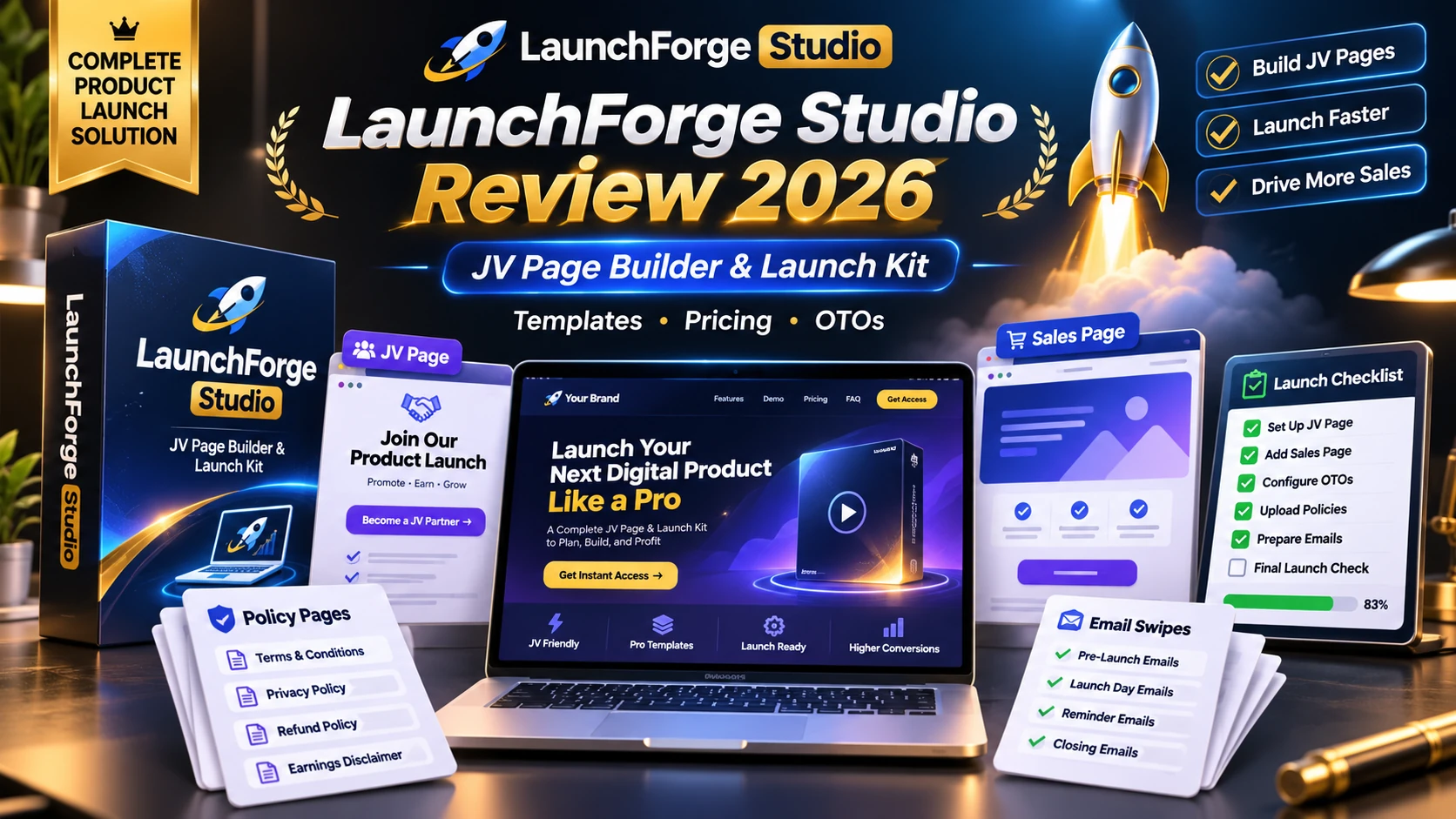
Featured review artwork
The image below illustrates the launch-kit workflow. It is not a screenshot of a completed vendor account.
LaunchForge Studio versus building the kit in WordPress
A WordPress user may prefer editable Gutenberg or Elementor pages with existing analytics and consistent themes. Exported HTML can be useful for a fast independent microsite, but it still needs hosting and maintenance. Compare mobile accessibility, content updates, analytics tracking and backup before deciding. Keep the exported launch kit distinct from the live WordPress affiliate review pages on AIReviewDock.online.
Final verdict: is LaunchForge Studio worth it?
LaunchForge Studio has a clearer niche than many generic AI tools: it organizes the pages and emails required around a real digital product launch. It is worth considering for first-time vendors who are comfortable editing HTML and reviewing policy drafts, but it cannot replace legal review, hosting or actual marketing validation.
No earnings, ranking position, launch approval, sales uplift or traffic improvement is guaranteed. Our review is intended to support an informed decision, not to substitute for a trial, current checkout terms or direct customer support.
Sources and editorial methodology
Checked November 13, 2026: official vendor product information and WarriorPlus affiliate offer and approval details. Features and prices attributed to vendors are not presented as independently tested outcomes.