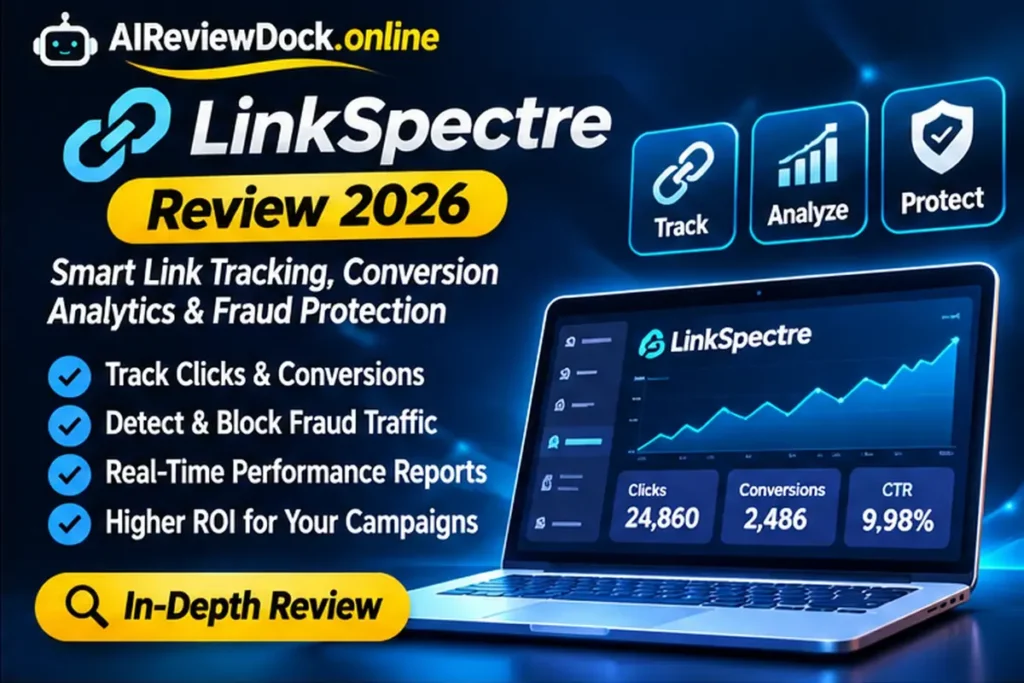
LinkSpectre review 2026: A click looks like a simple number until an affiliate tries to connect it to a real sale. Private messages, forwarded newsletters and social applications often send visitors without a useful browser referrer. LinkSpectre is marketed as a tracking and analytics platform that uses campaign links, channel reporting and traffic-quality signals to make those visits easier to interpret. Launched on the LaunchPad listing dated November 3, the offer matters to affiliates, paid-media managers and agencies who need evidence before spending more on a traffic source.
Our analysis is based on its LaunchPad affiliate listing and public descriptions. We have not purchased an account, tested its redirects or verified its bot-scoring accuracy. The platform’s advertised features, attribution claims and any displayed financial metrics must be checked in your own environment. This guide offers nine technical buyer checks, a realistic campaign setup, conversion math and risk controls so that a dashboard does not become another source of misleading statistics.
Affiliate disclosure: The four partner buttons in this article link to the seller’s LaunchPad offer. We may earn a commission if you purchase through one. There are no hidden affiliate links in the body, and no claim that the product guarantees profit.
Check LinkSpectre Plans and Actual Checkout
LinkSpectre Review 2026: Quick Overview
| Detail | What the available listing says |
|---|---|
| Name and market | LinkSpectre, click tracking and campaign analytics |
| LaunchPad offer | #624, shown under seller Muhammad Tahir Raza |
| Launch date | November 3, 2026 |
| Core purpose | Different tracked links per channel, fraud risk signals and campaign reporting |
| Possible extras | Redirect rules, A/B rotation, link-in-bio pages and agency features are marketed in public materials |
| Price | Varies across offers and network listings; verify the exact tier, renewal and checkout charges |
| Evidence level | Seller and public materials, no independent live-account benchmark |
Third-party calendars also contain a LinkSpectre listing under another marketplace and agency-facing sales description. That does not establish that every plan or bundle is identical across networks. Before paying, check the merchant displayed at checkout, domain, included product, invoice issuer and the refund conditions. The link provided here is the affiliate URL visible in the connected LaunchPad account, not an automatically inferred redirect to a different campaign.
What Is LinkSpectre and What Is Dark Social?
Dark social is a label analysts sometimes use for traffic whose original sharing context is obscured—often a link copied into a messaging app, private group, email or document. Some browsers strip referrers, and social apps may open an in-app browser. That can cause analytics to record a visit as direct or unknown. A purpose-built tracked URL can retain the campaign identifier the marketer chose when they created it, even if the visitor’s browser does not send a normal referring URL.
This still does not mean the software magically knows where every person first discovered an offer. If someone shares a Telegram-specific link in a WhatsApp group, the link will continue to carry the Telegram label unless other evidence is available. The honest claim is that disciplined link naming improves attribution; it does not restore an unknowable journey. For useful data, record the campaign, channel, placement, creation date and destination before publishing each link.
How Link Tracking Should Work in a Real Campaign
Suppose a marketer promotes one educational webinar through three channels: a newsletter, a Telegram community and a private WhatsApp group. Give each channel an independently named short link. Those links redirect to the same destination while keeping a channel identifier in the tracking system. A good dashboard should show accepted clicks, attempted visits, time, approximate geography and conversions only when a trustworthy conversion event is returned.
Separate link clicks from sessions and sales. Someone can tap a link twice, use a browser that blocks analytics, or switch devices before buying. The clicked platform may show a click but the affiliate network may not credit a conversion. Never present those counts as the same statistic. Check how LinkSpectre attributes the conversion if the original purchase occurs inside an external affiliate checkout that you cannot instrument.
9 LinkSpectre Buyer Checks Worth Doing
1. Verify first-party campaign naming and redirects
Create three unique short links for three controlled channels. Each should reach the intended destination without unexpected intermediate advertisements, unsafe domains or broken UTM parameters. Document whether the final link destination remains editable and if edits affect historical reports. For regulated products, check whether the redirect chain hides a disclosure or violates an affiliate network’s link rules.
Try the links on a Windows browser, Android browser and iPhone if you have authorized test devices. Keep an untouched control URL for comparison. A redirect taking too long or changing the product destination could reduce user trust even when the analytics dashboard reports clicks correctly.
2. Understand referrer data versus inferred channel identity
Ask exactly how the tool decides that a visit came from email, a messaging app or an organic source. Some reports use the label embedded when a link was created; others infer from a browser’s referrer. Those are not the same evidence. Test forwarding the same campaign URL between channels and see whether the tool explains attribution uncertainty.
In a buyer decision, prefer traceable identifiers over surprising claims about private messages. A product does not need to read users’ messages to measure tracked links, and it should not promise to reveal private communication content. If the dashboard uses a channel name without explaining its source, avoid treating it as a factual path.
3. Inspect the bot and fraud score
Public descriptions mention a score or quality signal for suspicious traffic. Ask which factors it uses: known data-center networks, unusually repetitive clicks, impossible device patterns or other heuristics. A signal that says “high risk” is useful only if the user can inspect and correct it. VPN users, shared offices and accessibility tools can be legitimate and still trigger unusual patterns.
Run a safe test on known human clicks and simulated duplicate visits. Review false positives and whether filtering affects raw reporting or simply adds a tag. Never treat an automated fraud score as proof a real person is dishonest. The tool should not quietly discard questionable clicks from a client invoice without an auditable policy.
4. Check conversion tracking and affiliate-network integration
A tracked click is not proof of a sale. Determine how a conversion enters the dashboard: browser pixel, server-to-server postback, manual import or vendor integration. Each method has limitations. If the affiliate seller does not provide a postback, the click tracker may not be able to reconcile earnings reliably. Check how transaction IDs are deduplicated to prevent counting the same conversion multiple times.
You should be able to see events that arrived, events rejected and the rule used for attribution. Verify whether a conversion remains assigned to its first link, latest link or another policy. Without a clear and consistent attribution model, channel profit statistics are only estimates.
5. Audit ROI, EPC and ROAS calculations
Earnings per click normally uses revenue or commission divided by a defined click count; return on ad spend uses an explicitly defined revenue measure divided by ad cost. Those calculations become misleading when refunds, processing fees, different currencies or affiliate-network holds are ignored. Ask whether the dashboard supports both gross and net figures, and whether the displayed currency is an exchange-rate conversion or a transaction currency.
Our affiliate link tracking checklist explains how to reconcile a click-reporting tool with the network, not merely display colorful traffic charts. Put example numbers into a spreadsheet to confirm formulas. Where commission payouts are not finalized, label profitability provisional.
Compare LinkSpectre Tracking Features and Offers
6. Compare click numbers with Google Analytics
Use the same campaign names and create a consistent UTM convention. Google Analytics supports manual campaign parameters for identifying marketing sources, mediums and campaigns, but results depend on consent, browser behavior and event capture. The counts may differ from LinkSpectre due to blockers, redirects, repeat clicks and sessions. That difference is not automatically a software bug.
Google’s campaign URL parameter documentation explains the UTM system. For one small controlled campaign, compare all three sources: tracker clicks, GA4 sessions and independently confirmed orders. Report the difference and what each metric actually measures.
7. Examine redirect rules and link safety
Geographic and device-based routing can be useful for authorized localization, but it also creates legal and affiliate compliance questions. Review whether redirects honor the merchant’s permitted countries and landing pages. A/B rotators should log the destination selected and avoid sending people to irrelevant or deceptive offers. Test fallback behavior when a destination is offline.
Do not use redirects to cloak prohibited content or hide the true seller. Verify that checkout, privacy notice and disclosure remain clear. Keep canonical product URLs in the editorial article and use the tracking layer only where the network permits it. This protects visitors and reduces accidental invalid traffic.
8. Review data retention, privacy and access roles
Tracking can process IP addresses, timestamps, device details and behavior that may be personal data. Ask how long raw logs are kept, whether IP addresses are truncated or hashed, and who can access client campaigns. Review regional privacy requirements before setting tracking on an audience. Agency subaccounts must be isolated so a client cannot view another client’s information.
The AI tool privacy checklist covers vendor access, data processors, backups, deletion and connected apps. If an external pixel or server webhook sends identifiers to another service, document where they go and whether consent or another legal basis is required.
9. Confirm plan caps, export rights, support and refunds
Ask how many tracked links, clicks per month, custom domains, workspaces and client accounts come with the specific LaunchPad edition. Agency white labeling and recurring reports may be extra. A low entry tier can make sense for one campaign but not for an agency processing millions of redirects. Confirm whether excess usage stops tracking, charges extra or silently samples reports.
Check CSV exports, API availability, campaign history on cancellation and whether you can replace tracked links without breaking published content. Ask for a written explanation of any advertised lifetime entitlement, support response expectations and refund eligibility. Never infer that every feature shown in promotional screenshots is part of the front-end price.
A Practical Seven-Day LinkSpectre Test
| Day | Controlled test | What to record |
|---|---|---|
| 1 | Create channel labels and approved destination URLs | Naming convention, destination and baseline conversion tracking |
| 2 | Share links with a small consented test audience | Clicks, unique visitors and possible duplicate counts |
| 3 | Forward a channel-specific URL into another app | Whether the channel label follows the link |
| 4 | Generate known test clicks | Treatment of repeated activity and fraud score |
| 5 | Run one authorized purchase or test conversion, if allowed | Evidence of a postback or conversion event |
| 6 | Compare tracker, GA4 and affiliate-network exports | Attribution mismatches and explainable differences |
| 7 | Export and review the campaign report | Permissions, retention, costs and whether the data justify a subscription |
You do not need to spend a large advertising budget to test the basic reporting logic. Use your own properly identified test campaigns and follow affiliate-network rules regarding self-purchases or simulated sales. If the platform or merchant prohibits test purchases, use an authorized test environment or omit that step. A tracker that cannot explain a basic controlled conversion should not receive unrestricted spending responsibility.
LinkSpectre Pricing, Upgrades and Total Cost
Multiple marketing listings describe LinkSpectre across different package ranges and networks, so we have intentionally not presented one price as universally current. At checkout, verify whether you are buying a LaunchPad one-time license, a recurring SaaS subscription, an agency tier or a different offer. Confirm the merchant, payment frequency, included click quota, custom-domain access, reports and all post-purchase upgrades. A promotional discount is not evidence of the cost of keeping campaigns active for the next twelve months.
Consider your total cost as license plus any renewal, custom domains, data storage, extra events and external analytics services. Then compare it with the administrative time saved by automated channel breakdowns. For a marketer running five email campaigns a month, precise UTM tagging may already be sufficient. An agency tracking dozens of paid placements may benefit more from dedicated automation and reporting, provided it can verify click and sale reconciliation.
View LinkSpectre Checkout and Included Tier
LinkSpectre vs Basic UTM Tracking vs Other Tools
| Option | Strength | Trade-off |
|---|---|---|
| Manual UTMs with GA4 | Low incremental cost and flexible campaign nomenclature | No built-in independent short-link management or sales postbacks |
| Simple URL shortener | Convenient sharing and elementary click counts | Often weak conversion, refund and fraud reporting |
| LinkSpectre-style tracker | One place for links, channel labels and quality reporting | Must verify event integrity, vendor dependence and exact plan limits |
| Custom server-side tracking | High control over data and business-specific logic | Engineering, security and maintenance costs |
The related QRiStudio review covers QR-code campaign links and business analytics, while our ReferralNow review covers referral attribution and reward verification. A tracked scan or click is not automatically a sale; compare each product against the actual conversion data you need.
Affiliate Disclosure and Consumer Trust
Attribution tools should support transparent marketing instead of disguising a commercial relationship. If you are paid for recommending a product, disclose the relationship clearly before readers act on it. The FTC’s endorsement disclosure guidance is a useful reference for U.S.-targeted campaigns. Other regions may require additional disclosures, consent or tracking notices. Keep evidence of what was promoted, what it cost and what claims were made.
A short tracking domain should not deliberately imitate a bank, brand or merchant. For client campaigns, keep ownership of the domain and have a documented process for rotating expired offers. Periodically crawl all tracked destinations for errors, suspicious redirects and broken disclosures. If a link begins pointing to a different product without editorial approval, suspend it until the change is understood.
Pros and Cons of LinkSpectre
- Potential strengths: organized campaign-specific links, channel comparisons, suspicious-click flags and exportable reporting, if the advertised implementation supports them.
- Potential strengths: A/B rotations and client workflows can reduce manual bookkeeping when traffic volume justifies them.
- Important limits: A tagged link cannot reveal the complete history of a user who forwards it elsewhere.
- Important limits: Clicks, sessions, leads, orders and paid commissions must be reconciled instead of combined.
- Important limits: Third-party integrations, plan caps, sensitive data handling and tracking accuracy remain to be independently tested.
LinkSpectre Frequently Asked Questions
Can LinkSpectre identify every WhatsApp or Telegram sale?
No tracking method can guarantee a complete journey when browsers, messaging apps, purchases and devices are disconnected. Campaign-specific links may improve measurement, but conversions need trustworthy event data.
Does a high fraud score prove that a visitor is a bot?
No. A score is a risk indicator and may produce false positives. Compare with raw logs and investigate before excluding people or billing clients.
Can I use LinkSpectre with an affiliate network?
Possibly, but check network rules on redirects, subidentifiers, masking and test conversions. The seller must provide the required conversion events for reliable sale attribution.
Is there a guaranteed lifetime plan?
The LaunchPad listing has an affiliate URL, but long-term entitlements and package limits must be read on the actual checkout and license terms. Do not assume every plan is lifetime.
Is this a hands-on test?
No. We did not log into a paid dashboard or measure production click quality. All buyer-test steps are recommendations.
Can tracking improve conversion rates by itself?
Measurement can reveal weak campaigns, but does not change the attractiveness, honesty or usability of an offer automatically.
What should an agency verify first?
Client account isolation, data exports, custom domains, reporting rights, support obligations, click limits and the ability to correct inaccurate attribution.
Final Verdict: Should You Buy LinkSpectre?
This LinkSpectre review 2026 finds a clear potential use case: organize campaign-specific links and provide more disciplined evidence than an unlabelled traffic source in a standard analytics dashboard. That is useful only if the system records accurate events, explains source labels and permits independent reconciliation. A fraud score or colorful profit chart without inspectable inputs should not justify a larger advertising budget. Start by defining what you must measure and how you will verify the number.
For solo creators, manual campaign parameters may solve most of the problem at lower cost. For active affiliates and agencies, a specialized tracker can be worth evaluating when advanced routing and reporting reduce work while preserving transparency. Inspect the exact tier and refund terms first, then use a seven-day controlled test. Editorial review: November 4, 2026. Plan availability and network details may change.