
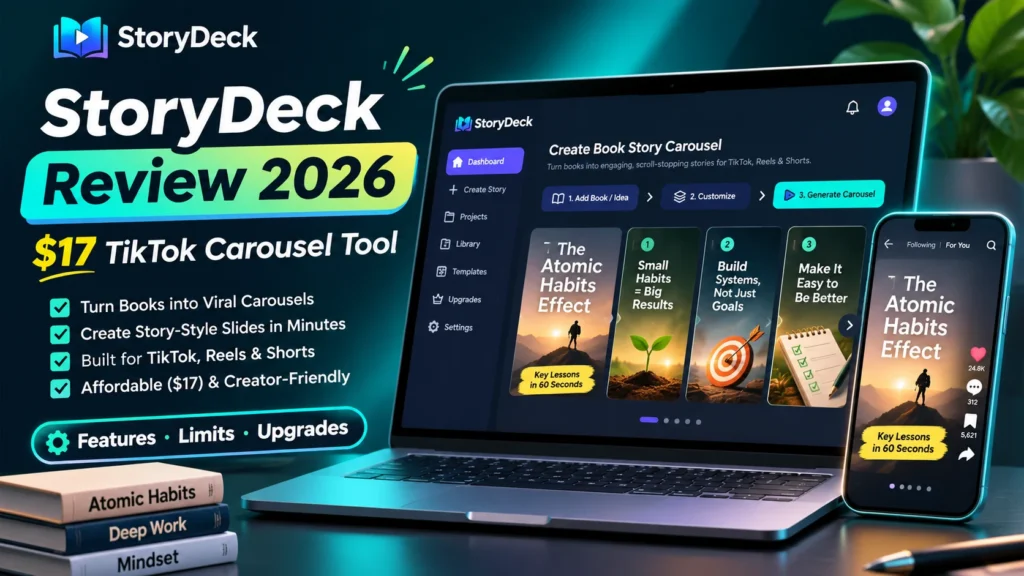
StoryDeck review 2026: StoryDeck is a book-promotion tool for authors and book affiliates, not an automatic book-sales engine. Its vendor describes a workflow that turns one passage from a book into a faceless storytime carousel, including a hook, an explicitly fictionalized story, an image of the real page and a final book-cover slide. The $17 Starter is appealing because it targets one narrow outcome rather than promising to replace an entire social media team. This StoryDeck review examines what a buyer actually receives, where the limits begin and when an upgrade may be necessary.
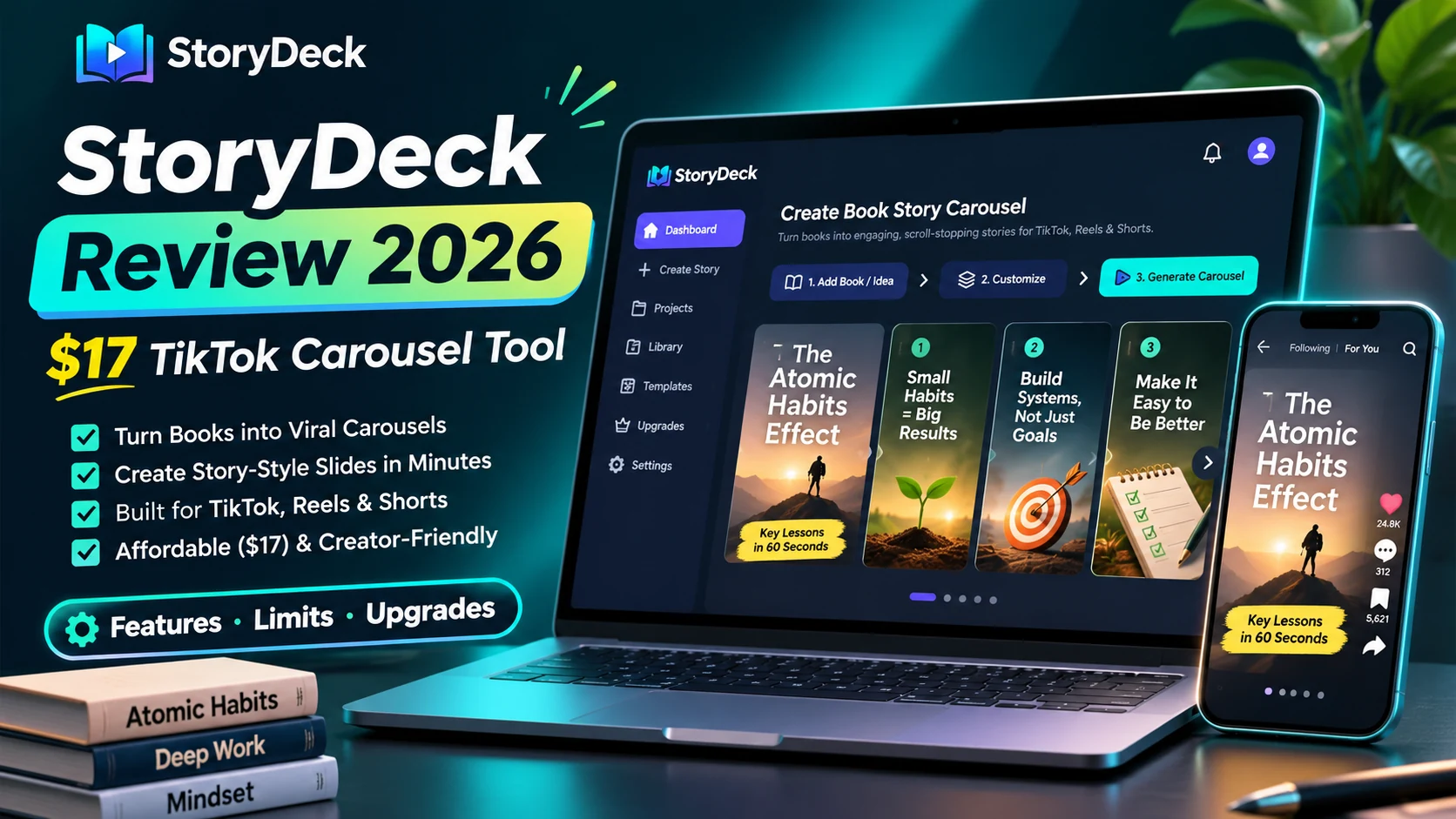
StoryDeck review 2026: At-a-Glance Buyer Fit
| Buyer need | What to verify |
|---|---|
| One book and TikTok Photo Mode | The advertised Starter supports one book and 9:16 static carousel slides. Check actual image quality and slide editability. |
| Multiple titles or client campaigns | Confirm the extra-book and commercial licensing terms before paying for upgrades. |
| Budget and repeat usage | Confirm the 50 included AI generations and any subsequent OpenRouter API charges. |
| Video-first social publishing | Starter advertises static slide exports, not native MP4 video creation. Plan for a separate editor if needed. |
StoryDeck review 2026 — Quick Verdict
StoryDeck is worth investigating if you already own or promote a book and want a repeatable TikTok Photo Mode content format. The biggest catches are the one-book Starter limit, English-only output, no video rendering, and the need to supply your own OpenRouter key after the 50 included generations. It does not guarantee traffic or sales.
What Is StoryDeck?
A person chooses a book and a page, then uses the software to prepare several story angles designed for a swipeable vertical sequence. The vendor shows six creative story frames and editable slides. It offers background photos, typography changes, captions and hashtags, with a 9:16 ZIP export for TikTok Photo Mode. Fiction inspired by a book should not be represented as a true anecdote.
Pricing and Features: What the Vendor Actually Lists
Price reference checked on November 15, 2026: $17 starter advertised; rises by $0.10 per sale according to vendor. These are vendor/launch descriptions. Prices, available checkout options, licenses and refund rules may change without notice.
Starter plan and scope
The official offer lists one book, English text, six story frames, a slide editor, TikTok 9:16 images, ZIP export and 50 initial AI generations. Those are vendor-listed features, not independently tested by AI Review Dock.
AI usage model
After included generations, ongoing AI generation requires the user’s own OpenRouter key, so the one-time product payment is not necessarily the total lifetime AI cost. Confirm supported models and the exact per-generation charges.
Editing and export
The product describes editable text, font, background photos and one-click background swapping. It exports static slides, not an MP4 video or native Pinterest/Instagram template in Starter.
Upgrade structure
The seller advertises paid upgrades for additional books, languages, formats, prepared stories and client workflows. A separate All Access bundle is marketed at $247 one time; check the live offer rather than assuming that number is permanent.
Who Should Consider This Tool?
This product is best considered by a buyer who already understands the target workflow and can check its output quality. Beginners should start with one small project, keep independent copies of finished assets, and make purchase decisions from specific features rather than from income screenshots or launch countdowns.
Eight Practical Checks Before You Buy
1. Start with one real book
Choose a book you have the legal right to quote and promote. Capture the exact page and edition so that the quoted line can be checked against the published text.
2. Generate two contrasting hooks
Evaluate whether the opening slide makes a concrete promise about the story, not a false claim of real events or guaranteed book sales.
3. Check passage accuracy
Make sure the tool has not changed the author’s words, fabricated a page number or shown the wrong edition in a background photo.
4. Test the disclaimer
Storytelling should be marked as fictionalized inspiration rather than a claimed true event. This is especially important when using dramatic first-person narratives.
5. Inspect mobile readability
Export the actual ZIP, open the slide files on a phone and inspect text size, safe areas, contrast and sharpness.
6. Measure time and token spend
Time one complete workflow including revisions, and record any OpenRouter charges so you can calculate cost per usable carousel.
7. Confirm commercial rights
Ask whether book-cover photographs, background images and templates may be used for commercial affiliate posts, and which user assets are retained.
8. Review upgrades one by one
Buy Starter first if one book and one output format meet your needs. Ask which exact feature forces an upgrade before accepting a bundle.
Pros and Cons
Potential advantages
- Focused book-to-carousel workflow instead of a vague do-everything AI suite.
- Vendor clearly lists Starter limitations and the 50-generation allowance.
- Slide editing and ZIP export provide more control than a single flattened image.
Important limitations
- Starter is restricted to one book, English and TikTok Photo Mode images.
- No native video in the basic package; repurposing requires extra work.
- Ongoing AI generation may incur usage-based charges with an external key.
- No promise of reach, conversion or book royalties.
Alternatives and Related Reading
Use these related tutorials and product reviews to compare the workflow before buying.
Related reviews: BookBloom Pinterest book-promotion review and PublishFlow KDP Studio buyer checks.
Independent educational guides: Amazon KDP AI content disclosure guide and AI tool privacy checklist.
Source checking: StoryDeck official plan and limits and FTC endorsement disclosure guidance. Product features attributed to a vendor are not the same as results independently verified in our account.
StoryDeck Review: A Practical Six-Slide Book Promotion Example
Imagine promoting a fictional adventure book in which a character finds an old letter at a railway station. A responsible six-slide carousel might start with a question that hints at the dilemma, then explain the setting, introduce the character, reveal a decision, show a verified short excerpt from the actual book, and end with the cover and a clear invitation to learn more. The sequence should be understandable even when viewers do not read a caption. Instead of claiming that a fictional event happened to a real person, the creator can call it a dramatized illustration of the story. That distinction protects reader trust.
In this StoryDeck review, that example is a suggested evaluation workflow, not proof that the platform generated those slides. Prepare the original quotation and cover image before opening the editor. Keep a record of the prompt, the number of times you regenerate the text, and any adjustments needed to make the images match the story. A reusable process is valuable only if it consistently produces legible, accurate and distinctive posts. If revisions take longer than assembling your own carousel, a dedicated product offers little practical benefit.
Book Rights, Excerpts and Marketing Disclosures
Book-related short videos can involve several kinds of rights at once. The author controls or licenses the text, the cover artwork may have its own license, and a background photograph might come from a stock provider with separate permitted uses. Do not assume the purchase of a creator tool grants permission to republish any book or cover. Authors generally have more control over their own books, while affiliates or book reviewers should check the publisher’s rules and how much material can be quoted. Using a brief quotation is not automatically allowed in every jurisdiction or for every promotional purpose.
Stories that use invented characters, dialogue or first-person events should identify the narrative as fiction or inspiration, not as a personal testimonial. Disclose a paid relationship or affiliate link where it can be noticed, not hidden beneath a long list of hashtags. These points matter particularly when an AI tool generates persuasive hooks. A compelling carousel can be ethical without being presented as a true confession or a claim of guaranteed income. The best StoryDeck review test is therefore not only visual quality; it is whether the finished post remains honest about its source.
Testing Mobile Readability Before You Publish
A desktop image preview can hide significant problems that appear on a narrow phone screen. Check each exported slide at the size where an audience will actually see it. Text should have sufficient contrast against busy backgrounds, and important words should not overlap captions or interface elements. Large blocks of copy are difficult to read during quick scrolling. One clear sentence, or a short question and its answer, often creates a cleaner visual rhythm than a complete chapter excerpt squeezed onto a slide.
Check slide order by opening the exported files outside the app; make sure the names and sequence stay consistent. Confirm that the final cover is not distorted and that a call to action does not imply endorsement from an author who has not granted it. If you plan to reuse images on a different social platform, check that platform’s format and cropping requirements first. The advertised Starter output focuses on static TikTok Photo Mode, so other formats and moving-video elements should be treated as separate production tasks.
Calculating Real AI Generation Cost
The launch material describes 50 included AI generations for the entry package and a bring-your-own OpenRouter key after that allowance. The exact conversion between a generation, a completed story and a final exported carousel should be checked in the account. One carousel might require several ideas, re-prompts and corrections; counting only the first draft will understate actual resource use. Keep a simple worksheet with a row for each post: topic, generations consumed, manual minutes, external API charges and whether the output was usable.
For illustration, suppose a creator produces four usable carousels from 20 generation attempts. That is five attempts per usable carousel, not one. This calculation does not predict the platform’s actual consumption; it demonstrates why a seller’s free-generation count is not equivalent to a guaranteed number of finished posts. If you advertise several books, the one-book Starter constraint could matter more than token charges. Compare the total upgrade and API costs with the effort required to make the same four posts manually in a general-purpose design program.
Measuring Content Performance Without Inventing Results
The first meaningful measurement is not a claimed viral reach figure. Set a goal for the next two weeks, such as creating six fully checked carousels for one book. Record preparation time, how often a hook needed a rewrite, whether a viewer saved the post, and whether the call to action led to a legitimate book-detail page. Use the platform’s own analytics to compare outcomes over the same time window rather than trusting an example screenshot or a seller testimonial.
Try changing one factor at a time. For example, use a question-led opening for one post and a character-led opening for the next while keeping the book and call to action consistent. Small samples cannot prove causation, but they can reveal whether the format suits your audience. The StoryDeck review decision should be based on controllable production quality and your real results, not promises that any specific slide will go viral. Keep failed examples as lessons rather than rewriting the published result later to imply a win.
Starter Versus Upgrades: Decision Checklist
Choose the lowest tier that fully supports the next realistic project. For a creator promoting one title in English through static carousels, the Starter description may be sufficient. A publisher managing several titles should request the specific multi-book entitlement, not assume that a generic bundle includes unlimited separate book workspaces. A social-media agency should verify client usage and account ownership, especially where different customers’ assets must remain separate.
Ask the vendor whether exported files remain accessible if a license changes, whether generation credits reset, whether commercial use covers paid client delivery, and what happens to uploaded passages and images. Confirm checkout currency, payment processor, refund conditions and support contact. No one should have to buy an expensive package solely because of an unverified launch countdown. A sensible StoryDeck review conclusion is a small, documented trial followed by a later upgrade only if output quality, rights and business need justify it.
Questions to Ask Before Buying StoryDeck
Ask the vendor to show an example exported ZIP from the current Starter version rather than relying solely on a polished screenshot. The sample should include the intended 9:16 image dimensions, slide order, typography controls and an editable working project. Ask exactly what counts as one AI generation: is it one complete story, a single revised hook, or one request to the underlying model? If a failed generation still consumes an allowance, that affects the value of the advertised first 50 generations. Clarify whether the OpenRouter key is stored securely, whether you can revoke it, and whether its costs are separate from the StoryDeck purchase.
Confirm whether the one-book limitation refers to one active project, a fixed ISBN, one cover asset or a lifetime entitlement. These conditions are materially different for a publisher producing new editions. Also ask which social formats are available in Starter and which are reserved for upgrades. Get a straightforward explanation of what the commercial license covers if you plan to promote books on behalf of clients. Finally, read the actual support and refund terms before checking out. None of these questions requires a seller to promise virality; they simply clarify what the buyer receives.
A Simple 30-Day Evaluation Framework
In the first week, make two carousels and record every step from selecting a passage to posting the final exported images. In the second week, create another two using different opening hooks while maintaining the same book audience. During week three, review actual post engagement and the quality of any traffic reaching the book page; avoid counting impressions as completed sales. In the fourth week, decide whether the most useful feature was idea generation, visual editing or the consistent export format. Calculate how much extra time or money the workflow saved, if any.
Retain an archive of the finished files and original text so you can recreate a post without depending on a vendor dashboard. If outputs contain recurring inaccuracies or you consistently spend more time correcting them than writing your own slides, stop upgrading and reconsider the tool. The product has a narrow enough purpose that a small repeatable test can answer the important buyer questions. Treat the StoryDeck review and its launch claims as a starting point for that evaluation, not as evidence of a specific income or publishing outcome.
Our Verdict
Our desk-research verdict is conditional: for a writer already prepared to make regular book-related posts, the $17 Starter can be a reasonable experiment. Buyers who need dozens of books, multiple languages or client workspaces should price the complete upgrade path first. We have not received verified hands-on review access and do not assign an invented performance rating.
Frequently Asked Questions
Does StoryDeck make TikTok videos?
Starter exports 9:16 still slides in a ZIP for TikTok Photo Mode. It is not advertised as a built-in MP4 video creator.
Is StoryDeck free after purchase?
The Starter license is advertised as a one-time product payment, but after the included 50 AI generations, your own OpenRouter API usage may cost extra.
Can I use it for Amazon affiliate books?
The product is positioned toward authors and affiliates, but you remain responsible for your affiliate disclosures, copyright permissions and the rules of any platform you post on.
Will a StoryDeck carousel sell more books?
No tool can promise that. Distribution, cover quality, audience fit, hook clarity and an honest call to action are still necessary.
Is the $17 price permanent?
No. The seller says the Starter price increases by ten cents after each sale and lists an upper launch ceiling. Confirm the live checkout before buying.
Editorial disclosure: This is a research-based buyer guide, not a hands-on product test. We do not promise results, savings, traffic or earnings. Links in this draft direct to the identified vendor or launch pages; tracking-link approval and current checkout terms must be verified before publication.