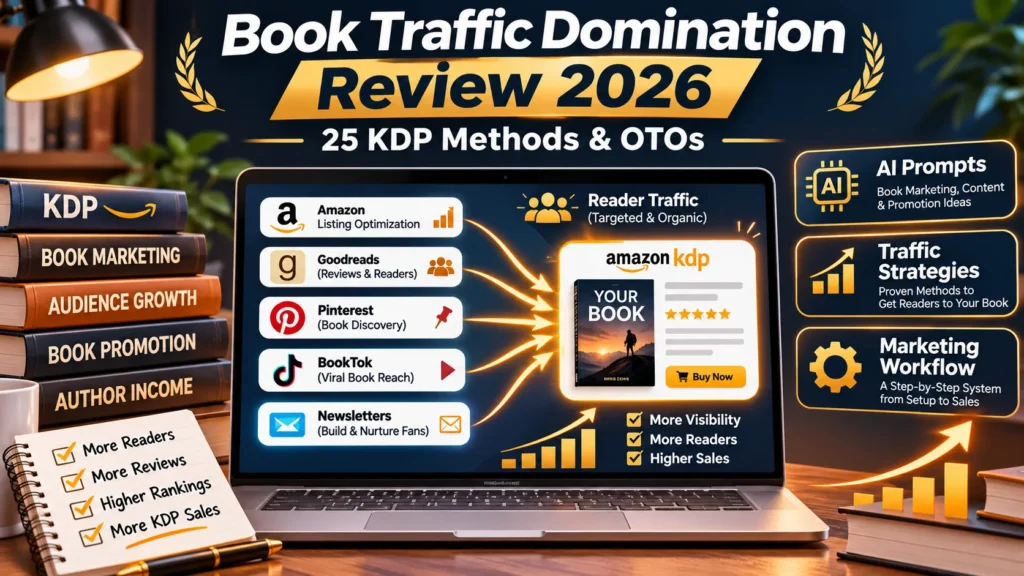
Book Traffic Domination review: This Book Traffic Domination review examines a reader-discovery toolkit launched through WarriorPlus on November 5, 2026 by Daniele Melandri. The vendor describes an interactive web app and guide with 25 free-traffic strategies, tailored AI prompts, a listing inspection tool, a thirty-day calendar and tracking tools for Amazon KDP authors. Unlike a book generator, its focus is bringing attention to books that are already published. We examined the seller’s public description and launch documentation; we have not purchased the app or attributed sales to its methods.
Editorial disclosure: This independent article relies on documented product and launch materials, not a claimed hands-on paid test. Affiliate referral links are pending authorization and are not active in this draft.
Quick Verdict
Book Traffic Domination is essentially a marketing workflow for self-published authors. The 25 methods cover Amazon listing improvements, reader communities, short-form video, ARC outreach and repeat readership. The advertised $17 launch price ended after the early November promotion; confirm the current checkout, generally described as a $27 regular offer, before assuming the old price is still available. Organic marketing requires time and does not guarantee readers or sales.
Book Traffic Domination review: Key Facts and Prices
| Vendor / network | Daniele Melandri / WarriorPlus |
|---|---|
| Launch date | November 5, 2026 |
| Historical launch front end | $17 for early launch; $27 regular price described in launch reviews |
| What is included | Web app, guide, walkthrough, 25 strategy prompts, Listing X-Ray, calendar, Reader Pulse Tracker |
| Supported book types | Fiction, nonfiction, children’s, puzzles, planners and low-content books |
| Not included automatically | Paid advertising, guaranteed placement, guaranteed reviews or instant book sales |
| Upgrade structure | Checkout bump and four upgrade groups in launch documentation |
| Evidence status | Public sales materials and launch descriptions, not a first-hand usage test |
What Is Book Traffic Domination?
Book Traffic Domination is not an AI ghostwriter that creates a new book for you. It is advertised as a traffic-planning system for authors who have already published on KDP or another marketplace. The buyer enters the title, book type, genre and intended reader. The app then offers 25 traffic strategies with prompts tailored to the book.
Those prompts are intended for use in tools such as ChatGPT, Claude or Gemini. The author generates content, reviews it and submits it to the relevant platform or community. This is an assistant for organizing marketing activities, not a distribution network that automatically inserts a book into recommendation feeds or sends visitors on its own.
Book Traffic Domination Review: The 25 Strategy Groups
The vendor groups the methods into Amazon Foundation, Discovery and Lists, Video and Social, Momentum and Reviews, and Owned and Repeat audiences. The Amazon section addresses book descriptions, keywords, A+ content, Author Central and sample pages. Those activities can help clarify a listing for people already viewing it.
The external-discovery group covers articles, Goodreads lists, reader questions and outreach to blogs. The social group includes BookTok hooks, short videos, Pinterest images and reader groups. Other methods deal with ARC teams, compliant review requests, newsletters, reader magnets and cross-promotion. Each requires judgment about where the audience actually spends time.
How the Tailored Prompt Workflow Is Supposed to Work
Start by defining a realistic reader profile. A children’s coloring book, for example, is primarily bought by parents, teachers or gift buyers rather than the child using it. Select a strategy that reaches the buyer, such as a Pinterest idea pin or a useful educational activity roundup.
The app then drafts a prompt that incorporates the book’s theme and audience. Use your AI assistant to generate the material, inspect every factual statement and decide where it belongs. A generic promotion dropped into unrelated Reddit discussions is unlikely to help; it may violate community rules. The strongest marketing is relevant and genuinely useful.
Listing X-Ray, 30-Day Calendar and Reader Pulse
The sales page describes a Listing X-Ray feature that scores an Amazon listing against 20 checks and suggests improvements. It also describes a thirty-day launch calendar and Reader Pulse Tracker. These can give a busy author a repeatable workflow and an easy way to record whether they updated descriptions or contacted reviewers.
Do not mistake an internal 0–100 listing score for Amazon’s own quality grade. Amazon does not owe a listing visibility because a third-party tool awards it a high score. Likewise, a tracker that records rank and reviews is a log of observed changes, not proof that a particular campaign caused every change.
The Pricing Question: Launch Discount Versus Current Checkout
Independent launch coverage describes a $17 front-end offer during November 5–8, 2026, with a $27 regular offer afterward. Since the initial promotion is over, it would be misleading to promise a $17 checkout today. Check the seller’s actual payment page and current guarantee before purchasing.
You should also check whether bonuses for the first 100 buyers are still offered. A time-limited incentive mentioned on the sales page may no longer be available, and a discount quoted by an affiliate may depend on its own campaign. The entry product should be worth buying without assuming a scarce bonus is included.
The Four Upgrade Groups and Checkout Bump
Launch documentation describes a checkout bump called Series Momentum Kit, followed by Book Traffic Domination PRO, Listing Lab, Reader Loop Machine and a higher-priced Digital Products Success Masterclass. Published launch figures list the bump at $12.97; upgrades commonly quoted are PRO $57, Listing Lab $47, Reader Loop Machine $37, and Masterclass versions at $197 or $397.
These prices are historical launch references, not guaranteed current checkout totals. PRO expands the marketing strategies and planning tools; Listing Lab focuses on the listing itself; Reader Loop emphasizes turning a reader into a repeat buyer; and the Masterclass teaches a wider business model. Buy only upgrades that solve a real bottleneck, and check refund terms for each separately.
Can the Free Traffic Methods Really Cost Nothing?
Many suggested channels can be used without buying advertising, but that does not make the work free. It takes time to create useful videos, write meaningful outreach and understand each community’s rules. Some promotional newsletters, software tools or professional designs may cost extra. The distinction between a free platform and zero total marketing cost matters.
Also remember that an unpaid campaign can fail. A reader community may reject a promotional post; a video may receive little distribution; a Pinterest pin may take time to gain impressions. The appropriate success measure is relevant visitors and eventual readers, not how many prompts the app can generate in one sitting.
Reddit, Goodreads and Review Policy Risks
A marketing guide that includes forums and reader communities must be applied responsibly. Do not create fake reader identities, manufacture recommendations or pay for favorable Amazon reviews. Read each subreddit’s promotion rules and contribute genuine, relevant answers without disguising an author promotion as independent praise.
For ARC teams, disclose relationships and follow Amazon’s current review policies. The seller’s claim that all strategies are completely safe is too broad to guarantee; users control how each strategy is executed. Properly handled outreach can be useful, but even a well-intentioned author can make a policy mistake if they copy a generated message without checking the rules.
A Practical Seven-Day Book Marketing Test
On day one, choose one already-published book and record its current category placement, conversion-related listing details and sales baseline where available. On day two, improve the description for readability. On day three, create one relevant Pinterest image. On day four, research one community where genuine readers discuss books like yours.
On days five and six, create one valuable article or short video and track whether it generates actual referral visits. Day seven is a review: what took time, what was accepted by each platform, what produced engagement and what should change? Avoid trying every strategy at once; doing so makes it hard to understand which activity is effective.
Who Should Consider It?
A solo KDP publisher who already has finished titles may benefit from a structured set of marketing prompts. An author with a small backlist can test selected strategies rather than inventing outreach from scratch every week. The calendar may be useful to someone who needs a realistic publishing-and-promotion routine.
It is less useful to someone with no finished book, an author expecting automatic sales, or a publisher who already has a measured marketing process. The guide cannot fix poor cover quality, unclear category fit, unattractive previews or a product that readers do not want. Improving the book and its listing remains essential.
Pros, Cons and Alternatives
Potential strengths are the 25 categorized prompts, book-specific customization, listing review and reminder-style calendar. It may combine tasks that beginners otherwise assemble from several blog posts and templates.
The tradeoffs are the labor required to publish, the risk of generic AI-generated outreach, time-sensitive platform rules and optional upgrades. Authors could alternatively research a few audience channels manually and maintain a spreadsheet. In either approach, thoughtful positioning and honest review policies matter more than automation.
Final Verdict: Is Book Traffic Domination Worth It?
Book Traffic Domination is most defensible as an organizational and idea-generation purchase, not a machine that creates demand. The entry price may be reasonable for a beginner who values a ready-made framework, provided the current checkout is acceptable and the prompts actually save time.
Our verdict remains conditional because we have not tested the private dashboard or verified sales outcomes. Compare the seller’s description with a free manual test of two traffic channels before purchasing an upgrade. No reviewer can promise that twenty-five strategies will produce twenty-five profitable streams of traffic.
Related Reviews and Buyer Resources
Compare the product with BookBloom author marketing review and PublishFlow KDP Studio review on AIReviewDock.online.
For educational context, see Amazon KDP AI disclosure checklist and Affiliate link tracking checklist on our separate AIReviewDock.com property.
Sources researched November 16, 2026: Book Traffic Domination official sales description and Independent launch and upgrade breakdown. Confirm current order terms before purchasing.
Book Traffic Domination review: choose one reader journey first
Before using a list of twenty-five strategies, map the journey a reader should take. A potential reader may discover a short video, visit an author page, read the book description, sample a chapter and then decide whether the book fits their interests. Each step should make the next one easier. If a social post promises a different topic from the book’s actual content, the traffic may be irrelevant even when the post receives clicks.
This Book Traffic Domination review recommends starting with one published title and one defined audience. Describe the reader’s problem, interests and preferred discovery channels. Then choose two promotion methods that match that audience. A children’s activity book may suit parent-focused Pinterest content, while a business guide may be better promoted through a useful newsletter or professional community.
Book Traffic Domination review: measure visits, not vanity metrics
Record a baseline before launching a campaign. Depending on the data available, track book-page visits, sample downloads, newsletter sign-ups, clicks from tagged links, category movement and sales. Social views or likes can show that a post was seen, but they do not prove that the right readers reached the book page. A simple spreadsheet can record date, channel, creative, link and outcome.
Use consistent tracking links where the platform permits them and avoid changing several campaign variables at once. If you update the cover, description and price on the same day you publish a video, it becomes difficult to identify what caused a change. The Book Traffic Domination review approach is to test one or two activities, review the results after a reasonable period and keep the channels that attract relevant readers.
Book Traffic Domination review: use communities without spamming
Goodreads groups, Reddit communities, reader forums and social groups have their own rules. Read them before sharing a book link. Contribute a useful answer or resource when it fits the discussion, and disclose your relationship to a book when relevant. Do not create fake accounts, disguise an advertisement as an independent recommendation or post the same generic message across unrelated communities.
AI-generated outreach should be edited to sound accurate and personal. Check the recipient’s interests, avoid misleading subject lines and give people a simple way to decline further messages. A strategy that gets an account banned or annoys potential readers is not a sustainable traffic source. This Book Traffic Domination review values genuine participation over raw posting volume.
ARC teams and review-policy safeguards
Advance reader copies can help authors gather early feedback, but a review must remain voluntary and honest. Do not condition a free copy, gift or payment on a positive rating. Never ask readers to change a review because it is critical, and do not write reviews on behalf of readers. Review platform rules can change, so check the current Amazon and other marketplace policies before recruiting an ARC team.
Keep the request neutral: readers may share an honest opinion if they wish, and no review is required. Separate editorial feedback from public reviews and avoid promising a particular rating. The Book Traffic Domination review should not imply that an app can guarantee positive reviews or manipulate marketplace ranking.
Build an owned audience with a reader magnet
A newsletter gives an author a way to communicate with readers who have chosen to hear from them. A reader magnet might be a bonus chapter, printable activity, checklist or short guide that is genuinely related to the book. The sign-up page should explain what subscribers will receive and how often. Use a reputable email service and include an unsubscribe option in every marketing message.
Do not add purchased email lists or scrape addresses from communities. Ask for consent, store subscriber data responsibly and follow the laws that apply to your audience. A Book Traffic Domination review can discuss list-building as a long-term channel, but the value comes from useful communication and reader trust rather than the size of a raw contact list.
A practical 30-day KDP traffic experiment
Week one: improve the book description, check the cover and confirm the sample represents the book accurately. Week two: publish one useful article or video aimed at the target reader and share it in a relevant channel where promotion is permitted. Week three: contact a small number of appropriate reviewers or bloggers with a respectful, personalized note. Week four: review tracked visits, engagement and any available sales data, then decide what to repeat.
Keep a record of effort as well as outcomes. A channel that produces a few highly relevant visits with little time may be more valuable than one that produces many low-intent views. This Book Traffic Domination review recommends treating the 30-day plan as an experiment, not a promise of sales or a fixed formula that works for every genre.
When organic traffic is not enough
Paid advertising can extend reach, but it introduces a budget risk and requires a book page that converts visitors. Before running ads, calculate the maximum cost per sale your royalty and price can support. Start with a small test, use relevant keywords and pause campaigns that spend without useful results. Do not assume that a larger advertising budget will fix an unclear cover, weak description or poor reader fit.
Authors with a small backlist may also test cross-promotion with writers who serve a similar audience. Agree on the format, timing and disclosure expectations. Avoid exchanging fake reviews or promising outcomes. A Book Traffic Domination review should present paid ads and partnerships as optional channels that require planning, not as guaranteed upgrades.
Questions to ask before buying the toolkit
- Does the current checkout include the full web app, guide and walkthrough?
- Which strategies require paid tools, subscriptions or advertising?
- Are prompts updated when platform rules change?
- Can the calendar and tracker export data for your own records?
- What exactly changes in PRO, Listing Lab and Reader Loop upgrades?
- What are the current refund terms for the front end and each upgrade?
- Can the seller show a real example of a campaign without claiming guaranteed sales?
Ask for the current order details because the original $17 launch promotion has passed. Save the checkout page and terms that apply to your purchase rather than relying on an older launch review. A useful Book Traffic Domination review also separates historical launch pricing from the offer available today.
Frequently Asked Questions
What does Book Traffic Domination do?
It provides 25 book promotion strategies, tailored AI prompts, a listing checker, a planning calendar and reader tracking tools.
Is the advertised $17 price still available?
That figure was tied to the early November launch window. Check the live checkout; reports describe a $27 regular price.
Will it write or publish a book?
It focuses on marketing published books. It is not primarily a book manuscript generator.
Does it buy ads for me?
No. The core pitch concerns free or low-cost discovery methods, though executing them takes time.
Can it guarantee Amazon reviews?
No. Avoid incentives or fake reviews and follow Amazon and platform policies.
Does it work without paid AI tools?
The vendor describes copying generated prompts into free AI chat products, subject to each provider’s limits.
Review Methodology and Disclaimer
We distinguish vendor promises from our independent assessment of practical buyer risks. We have not measured performance in a paid customer account. Affiliate commissions, discounts or review bonuses must be disclosed when activated and cannot be presented as guaranteed returns. This article will remain a draft until content and the final approved referral links have been reviewed.