BookPilot Review 2026: Is this AI publishing tool actually capable of producing an editable, Kindle-friendly book, or will you still need several additional services? This updated buyer guide compares its advertised workflow with the quality checks a real publisher must complete before purchasing. Evidence status: documentation and vendor-claim review, not a paid hands-on test; checkout terms and final software outputs have not been independently verified.
BookPilot: Quick Buying Verdict and 7 Essential Checks
BookPilot may be relevant to authors seeking a centralized research-to-export workflow. However, the decisive questions are not how many books a demo claims to generate or how quickly it produces a cover. Before paying, verify the following seven items with a current demonstration, sample output or written vendor policy:
- Topic research: can claims and sources be checked independently?
- Manuscript quality: does a full sample chapter read coherently without repetition?
- Human editing: can you fully revise the text and maintain your own writing voice?
- File exports: are editable formats and Kindle-compatible exports available in the exact package?
- AI disclosures and rights: what text and images are generated, and what commercial permissions apply?
- Full price: what is included in the entry checkout, and which steps require OTOs or added credits?
- Support and refunds: are the contract terms clear and documented?
Already comparing alternative AI book systems? Read our KDP Master Review and KDP Master vs BookSeries AI comparison. For the official disclosure policy, use Amazon KDP’s Content Guidelines.
Affiliate disclosure: This page contains affiliate links. AIReviewDock may earn a commission if you buy through them, at no added cost to you. Seller claims, terms and demo results are not independently verified unless explicitly stated.
Editorial note: This is a research-based review of the BookPilot offer promoted by Venkatesh and Visves through Launchpad. We have not logged into a purchased BookPilot account or independently verified the vendor’s income claims, so this review separates advertised features from what buyers should verify for themselves.
Publishing a book through Amazon KDP can look simple from the outside.
You write a manuscript, create a cover, upload the files, and publish.
In practice, there are many more steps between an idea and a finished book.
You may need niche research, keywords, an outline, chapters, illustrations, a cover, formatting, metadata, quality checks, and files that are ready for a publishing platform.
BookPilot is being promoted as an AI-powered system designed to bring many of those tasks into one workflow.
This BookPilot Review 2026 looks at the product from a practical publishing perspective: what it is supposed to do, which parts of the workflow may save time, where human review is still necessary, and what you should verify before buying.
Start With the Finished Book, Not the Sales Promise
The easiest way to evaluate BookPilot is not to ask whether it can generate text.
Plenty of AI tools can generate text.
The more useful question is:
Can it help you move from an idea to a book that is actually ready for careful review, formatting, publishing, and sale?
That means looking beyond the generation button.
A real publishing workflow includes:
- choosing a viable topic,
- planning the structure,
- creating original content,
- reviewing facts and language,
- checking images and rights,
- designing the cover,
- formatting the manuscript,
- preparing metadata,
- previewing the final file,
- and following the publishing platform’s rules.
BookPilot is positioned as a way to reduce the number of separate tools involved in that process.
What Is BookPilot?
The BookPilot offer covered in this review is an AI book-creation and publishing-preparation product promoted through a Launchpad campaign by Venkatesh and Visves.
It should not be confused with unrelated products and services using the same BookPilot name.
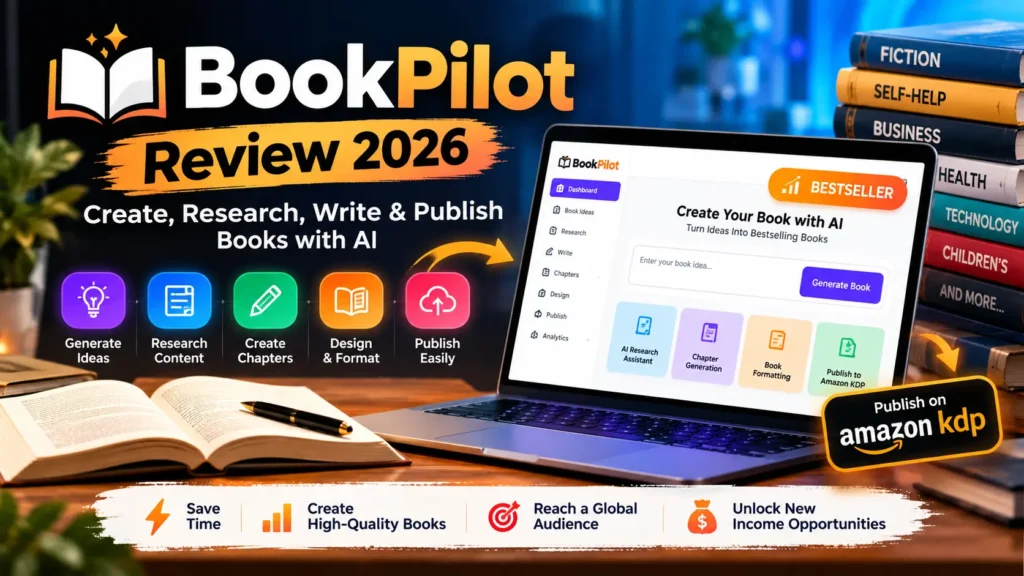
The launch material promotes BookPilot as a system that can assist with several parts of book production, including research, writing, artwork, cover creation, formatting, publishing preparation, and metadata-related tasks.
It is also promoted for multiple book formats and publishing ideas rather than only traditional long-form nonfiction.
The important point is that BookPilot is trying to be broader than a simple AI writing assistant.
If you only need help drafting text, our guide to the best AI writing tools for bloggers covers more general writing options.
BookPilot becomes more interesting when you specifically want an AI-assisted book production workflow.
The BookPilot Workflow: Where the Value Would Have to Come From
Instead of listing every advertised feature separately, it is more useful to follow the book from idea to export.
Stage 1: Niche and Topic Research
Every book starts with a subject.
For commercial publishing, however, a subject is not enough.
You also need to understand:
- who the book is for,
- what problem or interest it serves,
- how competitive the topic is,
- which keywords are relevant,
- and whether readers are likely to care about the finished result.
BookPilot is promoted with AI-powered niche and market-research capabilities intended to help users identify publishing opportunities.
This can be useful as a starting point, but research output should not be treated as guaranteed demand.
Search trends change, competition changes, and a profitable niche for one publisher may not work for another.
Stage 2: Outline and Manuscript Creation
Once a topic is selected, the next challenge is turning it into a coherent book.
A useful manuscript needs more than a large amount of generated text.
It needs structure.
Chapters should have a purpose. Ideas should not repeat unnecessarily. Facts should be checked. Examples should fit the audience. The tone should remain consistent.
BookPilot is promoted as being able to generate book content and support different types of books.
That may reduce drafting time, but human editorial review remains essential.
AI-generated text can still contain inaccurate information, repetitive passages, weak transitions, generic examples, or invented details.
Stage 3: Visuals and Illustrations
Visual content matters for children’s books, activity books, workbooks, covers, and other illustrated formats.
BookPilot is advertised with AI illustration and artwork capabilities.
This could reduce the need to move between a separate writing tool and a separate AI Image Generator.
However, generated images need the same level of review as generated text.
Check for visual errors, inconsistent characters, distorted text, inappropriate imagery, and any potential copyright or trademark issues before publishing.
Stage 4: Cover Design
A cover is not simply decoration.
It affects how the book appears in search results and whether the title looks credible to potential readers.
The BookPilot campaign promotes built-in cover creation as part of the broader workflow.
That could be convenient for someone who does not want to build every cover manually in a separate design platform.
Still, every cover should be checked carefully for readability, spelling, image quality, and consistency with the actual book.
Stage 5: Formatting and Export
This is where many first-time publishers discover that writing the book was only one part of the job.
A manuscript also needs to display correctly.
The BookPilot offer promotes export and formatting capabilities for publishing-ready files, including formats associated with digital and print publishing.
Before uploading anything to KDP, preview the final file yourself.
Amazon’s own quality guidance recommends reviewing books for missing content, typos, formatting problems, image quality, navigation, and other issues before publication.
Stage 6: Publishing Preparation
BookPilot is also promoted around metadata and publishing assistance.
That may include help with elements such as:
- titles,
- descriptions,
- keywords,
- categories,
- and listing preparation.
Automation can make these steps faster, but the final responsibility still belongs to the publisher.
Metadata should accurately describe the book rather than simply stuffing popular keywords into the listing.
Important: Amazon KDP Has Rules for AI-Generated Content
This part should not be ignored.
Amazon currently requires publishers to inform KDP when a book contains AI-generated text, images, or translations. Amazon distinguishes AI-generated content from AI-assisted content.
You can review the current Amazon KDP Content Guidelines before publishing.
If an AI tool created the actual text or images used in the book, editing that material afterward does not automatically make it non-AI-generated under Amazon’s definition.
Publishers are also responsible for making sure the material follows intellectual-property and content-quality requirements.
So, even if BookPilot automates part of the process, you still need to understand the rules of the platform where you publish.
What Types of Books Is BookPilot Promoted For?
The launch material positions the product for a wide range of publishing formats.
Promoted examples include:
- traditional written books,
- children’s books,
- storybooks,
- journals,
- planners,
- workbooks,
- puzzle books,
- activity-style books,
- and other digital or print-oriented projects.
That flexibility sounds attractive, but different book types require different quality standards.
A children’s picture book needs visual consistency.
A nonfiction guide needs factual accuracy.
A puzzle book needs correct solutions.
A workbook needs usable exercises and enough space for the reader to interact with it.
Therefore, one generation workflow should not be treated as equally suitable for every book category without review.
Where BookPilot Could Save the Most Time
The strongest potential benefit is not that AI can write words quickly.
The stronger benefit is workflow consolidation.
A traditional process may require:
Research tool → AI writer → image generator → design software → formatting tool → metadata research → publishing dashboard
BookPilot is marketed around bringing more of those activities into one environment.
For users who repeatedly create books, reducing tool switching may be valuable.
The same principle applies across AI content workflows. Our guide to the best AI tools for content creation explains why the right combination of tools matters more than simply collecting the largest number of AI subscriptions.
BookPilot Pricing: Use the Live Checkout
The BookPilot launch is listed as starting on October 1, 2026.
Public launch calendars have listed the front-end around the $27 level, while promotional pages and affiliate materials may show different discounts or funnel prices.
Because launch pricing can change, the safest approach is to use the live offer page before buying.
Check:
- the current checkout price,
- exact front-end features,
- usage limits,
- upgrade requirements,
- commercial-use terms,
- refund conditions,
- and whether any feature you need is only available in an upgrade.
Do not assume that every feature mentioned across a sales funnel is included in the entry package.
BookPilot Pros
- Combines several book-production stages into one advertised workflow
- Can reduce the need to switch between multiple AI tools
- Research and niche-discovery features may help with early planning
- AI writing can accelerate first-draft creation
- Artwork and cover capabilities may help visual book projects
- Formatting and export tools target a common publishing bottleneck
- Promoted for several book types rather than only one format
- Potentially useful for creators building a repeatable publishing workflow
- One-time-payment launch positioning may appeal to users avoiding another monthly subscription
BookPilot Cons and Risks
- We have not independently tested the purchased dashboard
- AI-generated manuscripts still need detailed human editing
- Generated images can contain visual errors or consistency problems
- Vendor income claims should not be treated as typical or guaranteed results
- Amazon does not guarantee approval simply because a tool created the files
- KDP requires disclosure of AI-generated content
- Book quality, demand, competition, and marketing still affect sales
- Some promoted capabilities may depend on upgrades or package limits
- Automated niche research cannot guarantee that a topic will be profitable
- Publishing multiple low-quality books quickly can create a poor reader experience
What I Would Verify Before Buying
Instead of buying based only on the headline, check these points on the live offer.
1. What exactly is included in the front-end?
Make sure the feature you want is actually included in the product you are purchasing.
2. What are the real usage limits?
If the page uses words such as unlimited, check whether there are fair-use limits, generation credits, API limits, or technical restrictions.
3. What export formats are available?
Confirm that the output works for the publishing format you intend to use.
4. How much editing will the generated book need?
The best test of an AI book platform is not how quickly it generates a manuscript.
It is how much work remains before you would confidently put your name on that manuscript.
5. What happens if Amazon rejects the book?
No third-party AI tool controls Amazon’s approval process.
The publisher remains responsible for compliance and quality.
BookPilot vs Using Separate AI Tools
Check export compatibility: Our interactive eBook vs PDF vs EPUB comparison explains how format choice affects accessibility and distribution.
There are two basic approaches.
Approach A: Separate Tools
You could use one AI tool for research, another for writing, a separate image generator, design software for the cover, and another application for formatting.
The advantage is flexibility.
You can choose the strongest tool for each job.
The disadvantage is complexity, subscriptions, file transfers, and a more fragmented workflow.
Approach B: BookPilot
BookPilot’s value proposition is convenience.
Instead of assembling your own technology stack, the platform is promoted as a more unified publishing workflow.
The trade-off is that you depend more heavily on the quality and limits of one system.
For some users, convenience will matter more.
For others, choosing specialist tools may produce better control.
Who Should Consider BookPilot?
BookPilot may be worth investigating if you:
- want to experiment with Amazon KDP publishing,
- regularly create digital or print books,
- want AI assistance across more than just writing,
- prefer a consolidated workflow,
- create journals, planners, workbooks, children’s books, or long-form content,
- understand that AI output still requires review,
- and are willing to learn KDP’s publishing rules.
Who Should Probably Skip It?
BookPilot may not be a good fit if you:
- expect fully passive income simply by pressing a button,
- do not want to review AI-generated content,
- need guaranteed Amazon approval,
- already have a publishing workflow you are satisfied with,
- only need occasional writing assistance,
- or are uncomfortable checking licensing, rights, metadata, and quality yourself.
Frequently Asked Questions
What is BookPilot?
BookPilot is an AI book-creation and publishing-preparation product promoted through a Launchpad campaign. It is marketed around research, writing, visuals, cover creation, formatting, and publishing workflow assistance.
Is BookPilot an Amazon product?
No. BookPilot is a third-party product. Amazon KDP is a separate publishing platform with its own rules and approval processes.
Can BookPilot create complete books?
The vendor promotes complete book-creation capabilities, but generated content should still be carefully edited, fact-checked, and reviewed before publication.
Can I use BookPilot for Amazon KDP?
It is specifically promoted toward book creation and KDP-style publishing workflows. However, you remain responsible for ensuring that the finished files and content comply with Amazon’s current requirements.
Does Amazon allow AI-generated books?
Amazon KDP currently permits AI-generated content subject to its content rules, but publishers must disclose AI-generated text, images, or translations during the publishing process.
Does BookPilot guarantee book sales?
No. A tool cannot guarantee sales, rankings, royalties, or passive income. Results depend on factors such as book quality, demand, competition, pricing, metadata, marketing, and reader response.
Can BookPilot create covers and illustrations?
Cover and illustration creation are among the capabilities promoted in the BookPilot launch materials. Review the output carefully before using it commercially.
Is BookPilot a one-time payment?
The launch is promoted with one-time-payment positioning. Confirm the current checkout, upgrades, and any usage conditions on the live offer page before purchasing.
What is the current BookPilot price?
Launch pricing can change. Public launch listings have shown a front-end around $27, but the live checkout should be treated as the current source for the actual price.
Final Take
BookPilot is interesting because it is trying to solve a larger problem than AI writing alone.
The difficult part of self-publishing is not simply producing words.
It is coordinating research, writing, visuals, covers, formatting, metadata, quality control, and publishing requirements.
A platform that genuinely reduces friction across those stages could be useful.
At the same time, the most important word in AI publishing is still review.
Do not publish a generated manuscript simply because the software says it is finished.
Read it.
Fact-check it.
Check the images.
Preview the files.
Confirm the metadata.
Understand Amazon’s current AI-content rules.
And treat promotional income examples as marketing claims rather than predictable outcomes.
If BookPilot’s consolidated workflow matches the type of books you intend to create, the offer may be worth exploring. If you only need occasional AI writing help, a simpler tool may be enough.
Editorial note, updated 13 October 2026: This is a documentation-based review. Affiliate checkout prices and platform capabilities can change. Check the vendor’s live written terms before purchasing, and do not treat software marketing claims as guaranteed performance.