Affiliate disclosure: AI Review Dock may earn a commission from links in this review without increasing your price. Our analysis uses available sources; we have not personally purchased or tested RoyaltyShelf AI.
RoyaltyShelf AI Review 2026: Publishing-Quality Checklist
A credible RoyaltyShelf AI review should evaluate a complete bilingual book, not a screenshot of a language dropdown. Children’s books are a demanding use case because every word, illustration and activity must be understandable to the intended reader. Automated translation can help produce a first draft, but a native speaker or qualified editor should review grammar, tone, cultural fit and reading level before publication.
Build one small sample with a clear brief: a twenty-page picture book about garden animals for early readers. Specify the two languages, age range, character descriptions, page count and visual style. Once the generator produces the draft, inspect whether characters look consistent, whether dialogue matches the illustrations and whether the translated text fits the page without becoming cramped.
Translation quality and human checking
Check the two language versions sentence by sentence. A literal translation can change humor, tone or implied meaning, while grammatical mistakes may look plausible to someone unfamiliar with the language. Ask a native speaker to read the entire book aloud. Keep a correction log, and determine whether a change in one language also requires reflowing the layout in the other. A RoyaltyShelf AI review should describe those workflow costs rather than promising instant multilingual publication.
Book-production and KDP export tests
Open the files in a print previewer and check bleed, trim size, safe margins, page ordering, cover artwork and font readability. If the product creates activity books, complete each puzzle to ensure the answers are valid. Order a proof copy where appropriate. Files advertised as platform-ready still need to meet the current marketplace requirements, including AI-content disclosures when applicable.
Copyright and licensing are equally important. Confirm commercial permission for generated illustrations, templates and fonts. Avoid using copyrighted fictional characters or making a cover that implies endorsement by another author. Keep a record of your editing and source materials. A low-cost license cannot guarantee that every result will be suitable for resale.
How to estimate the real publishing budget
Translation review, proof copies, graphic refinements, metadata preparation and marketing may cost more than the initial software purchase. For example, a $100 combined spend on editing and proofing would require twenty book sales if the contribution per sale were $5. This is an illustration only; actual royalties depend on format, price, marketplace and production expense. The meaningful metric is profit from a well-received book, not the number of books generated.
If additional languages are sold as upgrades, test the base language pair before purchasing expansion packs. More languages create a larger need for editorial oversight. The RoyaltyShelf AI review recommendation is to finish one book to a level that parents and educators can trust before planning a large catalogue.
Pre-purchase checks: supported language pairs, editable source files, commercial licenses, book and page limits, KDP export specifications, total checkout costs and vendor support. A good RoyaltyShelf AI review should empower publishers to assess each of those details before spending.
RoyaltyShelf AI is a LaunchPadJV offer from ClicksBotz that focuses on bilingual book creation. Public marketing describes children’s storybooks, activity books, coloring books and related printable products in English paired with languages including Spanish, French, German and Portuguese. The promise is to make a complex production process easier: draft content, prepare illustrations, lay out two languages and export books for marketplaces such as Amazon KDP.
The idea is compelling, but a bilingual children’s book is a demanding product. Parents and teachers expect accurate translation, natural phrasing, suitable reading levels, clear typography and consistent artwork. Making an English-only draft readable does not prove a second-language edition is equally good.
This RoyaltyShelf AI review is a buyer-focused assessment drawn from the launch listing and publicly reported features, not a claim that we have used a paid account or published a RoyaltyShelf-generated book. We concentrate on editorial quality, export reliability, platform rules, optional upgrades and the real cost of a book business.
Why bilingual publishing requires more than translation
Consider an original picture book about a child caring for a garden. In English, a playful sentence may rhyme; in German or French, a literal translation may lose the rhyme or become too long for the illustrated page. A word that seems simple to an adult can also be difficult for a six-year-old reader. The creator must choose between preserving exact phrasing and preserving a natural reading experience.
A proper bilingual workflow starts with a tested story in the primary language, then a second-language version edited for tone, grammar, idiom and age level. Both texts should match the illustrations and occupy readable space. Even a very good AI translator may make subtle choices that a native speaker would revise.
If RoyaltyShelf has language-quality checking tools, ask the vendor what those tools actually do. Do they identify spelling only, or do they review idioms and meaning? Can an author edit one language without disturbing the other? Can both versions be exported for outside proofreading? These specifics matter more than how many languages appear in a dropdown.
Check Current RoyaltyShelf AI Offer
The claimed workflow from idea to KDP export
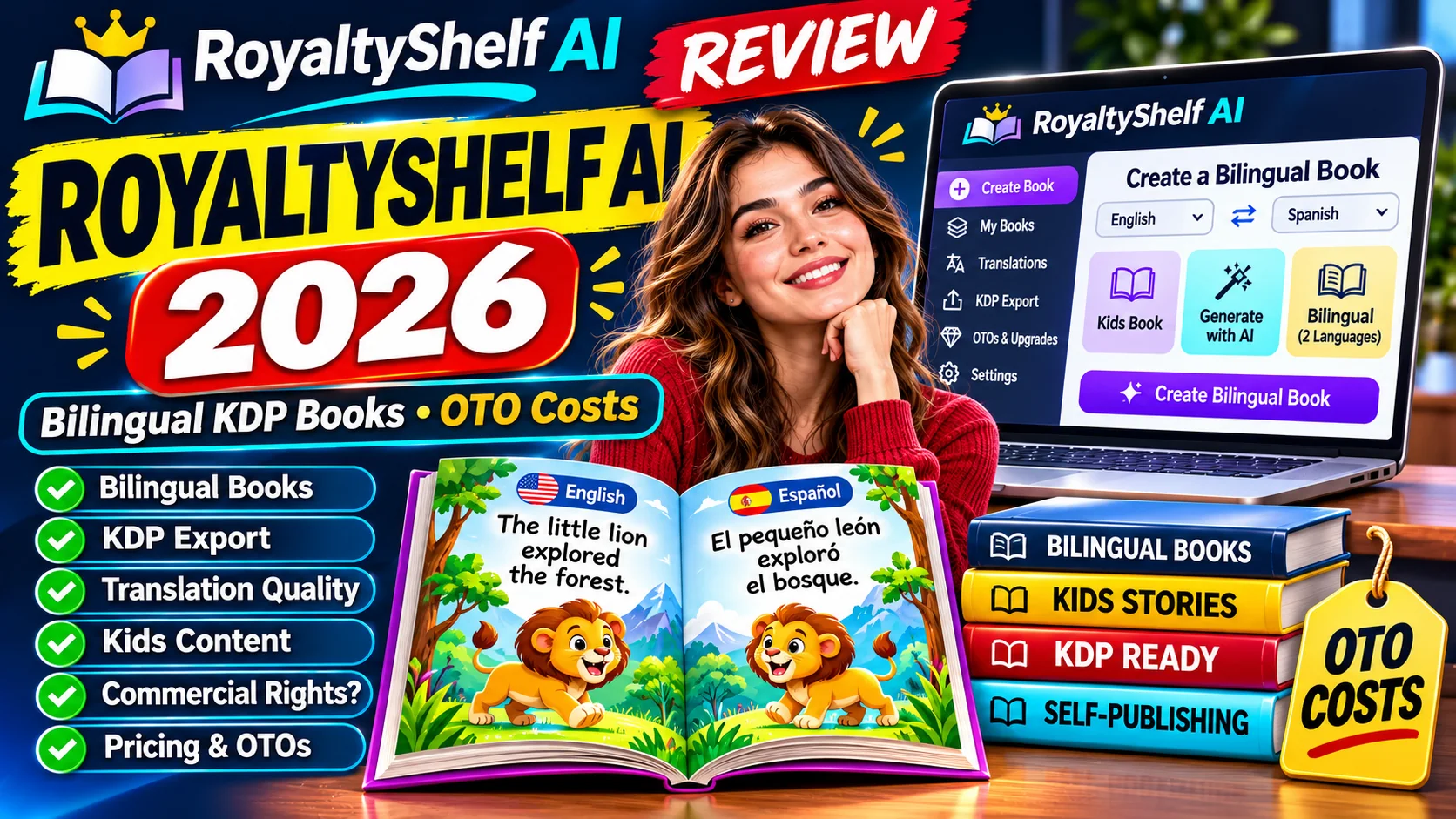
Launch descriptions suggest a process of choosing a book concept, drafting the text, generating artwork, arranging a bilingual layout and downloading publishing files. The practical test is whether a creator can produce a complete book without losing control over its content. A sample dashboard image cannot demonstrate that every page meets KDP specifications.
Begin with an outline that defines audience, length, main character and reading objective. Generate a small sample, then check whether the plot has a beginning, middle and end. Review illustrations for stable character appearances and meaningful connections to the story. Test the translation against the revised—not an outdated—primary text.
Next inspect the file itself. Verify trim size, bleed, safe text margins, page numbering, embedded fonts, readable contrast and the export format. Open a proof in Amazon’s previewing workflow and order a printed proof where appropriate. A file labelled ‘KDP-ready’ should still pass these ordinary publishing checks.
Amazon’s AI and quality requirements
Amazon’s official KDP Content Guidelines distinguish AI-generated content from AI-assisted content. Publishers are responsible for rights and complying with disclosure requirements when applicable. That includes the text, generated illustrations and potentially AI-produced translations. Using a third-party book application does not transfer those responsibilities to the vendor.
Amazon also evaluates content quality. A book with illegible text, inconsistent pagination, poor image resolution or a misleading description can disappoint customers even if it passes an initial upload. KDP approval and sales are not guaranteed merely because an application produces files in the right format.
Rights also matter. Check whether the software’s license grants you commercial publication rights and whether any included visual assets, templates or fonts carry separate restrictions. Avoid protected characters, copied storylines and artwork that imitates a known creator without authorization. Keep proof of your source materials and editing decisions.
What a book-quality check should include
Read the entire book aloud in each language. Look for unnatural phrases, inconsistent character names, factual mistakes, missing sentences, repeated paragraphs and age-inappropriate vocabulary. For activity books, test every puzzle or exercise and verify any answer keys. A generated word search with an incorrect solution is not a minor cosmetic problem; it undermines the product.
Inspect images at print resolution, not only in a small browser preview. Look for malformed hands, distorted objects, inconsistent props, unreadable embedded text and mismatched scenes. Print at least one sample spread to see how the colors and line work translate into physical output.
Check the relationship between the two languages. If one text contains three paragraphs while its counterpart has five, verify whether the meaning was preserved or the model introduced extra material. A qualified bilingual editor or native speaker is the most reliable final check. Automation may make first drafts faster, but it does not erase editorial responsibility.
What is included in the launch price?
Public launch sources quote a front-end offer around $14–$17 depending on the promotion. Prices can change by coupon, location and checkout timing, so the exact payable amount for November 19 should be checked directly. The affiliate marketplace displays an active offer, but that alone does not prove which advertised features belong to the basic tier.
Several competitor breakdowns discuss upgrades for more language pairs, additional marketplaces, production capacity, promotion assets and resale rights. Public OTO tables are not always identical. Before purchasing, ask for the precise list of what your chosen license includes: page or book limits, export formats, artwork rights, supported languages, quality checks and any separate AI credits.
A lower entry price may be appealing for a hobbyist, but professional publishing adds costs such as proofreading, cover refinements, proof copies, ISBN decisions, advertising and customer support. Do not compare the app’s purchase price with book royalties without including those expenses.
The numbers behind a bilingual book
Imagine a title that yields an illustrative $4 contribution per paperback after printing and platform charges. Spending $120 on translation review, proof copies and design corrections would require 30 sales to recover those production costs, before any advertising or taxes. The numbers are only a hypothetical example; royalty formulas depend on actual KDP pricing, marketplace and printing specifications.
A better business model begins with demand research. Identify a specific group of readers and assess whether existing books solve their needs. One differentiated, carefully edited book is often more valuable than ten generic bilingual books competing for the same search terms.
Remember that content can need updates. A book about travel, technology or current facts can age quickly. Children’s stories may last longer, but translation quality, licensing and print specifications still require attention. A generator cannot replace customer feedback or sustained product improvement.
Advantages, limitations and who should consider it
Potential advantages: guided bilingual layout, help with initial story and illustration drafts, faster preparation of language-paired materials and a potentially affordable starting point for a creator learning children’s publishing. These are potential benefits of the concept, not independently tested performance claims.
Important limitations: translation must be validated by humans, illustration quality varies by generation, KDP rules remain the publisher’s responsibility, and extra languages or rights may be locked behind upgrades. Without a working account, we cannot confirm the vendor’s export reliability, support response or exact output quality.
RoyaltyShelf may fit a teacher or careful hobbyist who wants structured drafts and can recruit native-language review. It is a poor fit for anyone hoping to upload dozens of automatically generated books without proofreading. For related book-production and promotion questions, explore our StoryMaze Studio review and Book Traffic Domination review.
Three practical sample tests for a bilingual book generator
Test one: a single illustrated story. Prepare a brief for a ten-page book about sharing toys. Specify a six-to-eight-year-old reader, two recurring characters and one language pair. Assess whether names, actions and illustrations stay consistent. Ask a native speaker to review the translated version. If the story changes meaning or contains awkward phrasing, document the corrections required rather than treating the output as complete.
Test two: a short activity workbook. Generate a set of matching activities, word searches or simple puzzles. Complete every activity by hand and verify the answer key. Check grayscale print quality, page margins and whether the fonts remain legible after export. This test is more revealing than a visually impressive cover because it proves that a customer could use the product as intended.
Test three: an expanded language edition. If an upgrade promises extra languages, translate an already approved book into one of those languages. Ensure the artwork, layout and metadata remain coherent. Check whether the new edition can be edited independently of the original. This helps determine if a larger language package brings real value or merely adds more drafts that each need professional review.
Cover design, listing metadata and the customer experience
A book’s cover should accurately communicate its genre, language pair, age level and physical format. A title such as “Learn French Fast” could mislead buyers if the interior is only a short picture story. Preview images should show genuine sample pages, not mockups that imply more content than the file delivers. Where the platform automatically writes the sales description, check every promise against the actual book.
Think about the buyer after the sale. Does the book contain a pronunciation guide where helpful, clear page order, age-appropriate instructions and useful context for parents or educators? Does the listing explain whether the book is primarily a story, a beginner vocabulary aid or a puzzle workbook? Those distinctions reduce refunds and disappointed reviews. Reliable value comes from an accurate learning experience, not from publishing the highest number of automatically generated titles.
Nine checks before you buy
- Confirm the exact language pairs in your license.
- Request a sample full-length bilingual book, not only a cover mockup.
- Verify manual editing options for each language.
- Check print-ready export, trim size and bleed support.
- Ask who owns the generated text and illustrations.
- Review book/page limits, credits and fair-use policies.
- Check which marketplaces are supported and what publishing automation really means.
- Compare all optional OTO costs and commercial/reseller licenses.
- Budget for independent proofreading and a physical proof before selling.
Keep a record of the sales claims and the actual checkout terms. If you cannot obtain a complete sample with consistent bilingual pages, defer the purchase until you can verify output quality. Translation is too important to judge from promotional snippets.
Frequently asked questions
Does RoyaltyShelf AI automatically publish on Amazon KDP?
It is promoted as KDP-focused, but confirm whether it provides export files for manual upload or a supported account integration. Marketplace approval is not guaranteed.
Are AI-generated translations acceptable?
The publisher must assess rights, accuracy, disclosure and platform policies. Human review is especially important for children’s material.
Is a launch-price purchase enough to create unlimited books?
Do not assume so. Check book limits, page caps, generation credits and fair-use terms for the actual edition.
Will the tool generate book sales?
No. Customer demand, content quality, pricing, reviews and promotion determine sales—not the availability of an export button.
Our final assessment
RoyaltyShelf AI targets a specific problem that general content generators often handle poorly: drafting and laying out bilingual children’s material. If the software provides genuinely editable, accurate and rights-cleared outputs, it could save creators meaningful setup time.
The decisive issue is proof of quality. Test translation with a native speaker, inspect a complete print file and confirm KDP disclosure responsibilities before paying for extra features. We would treat RoyaltyShelf as an editorial assistant, not a guaranteed publishing business or a replacement for professional review.