
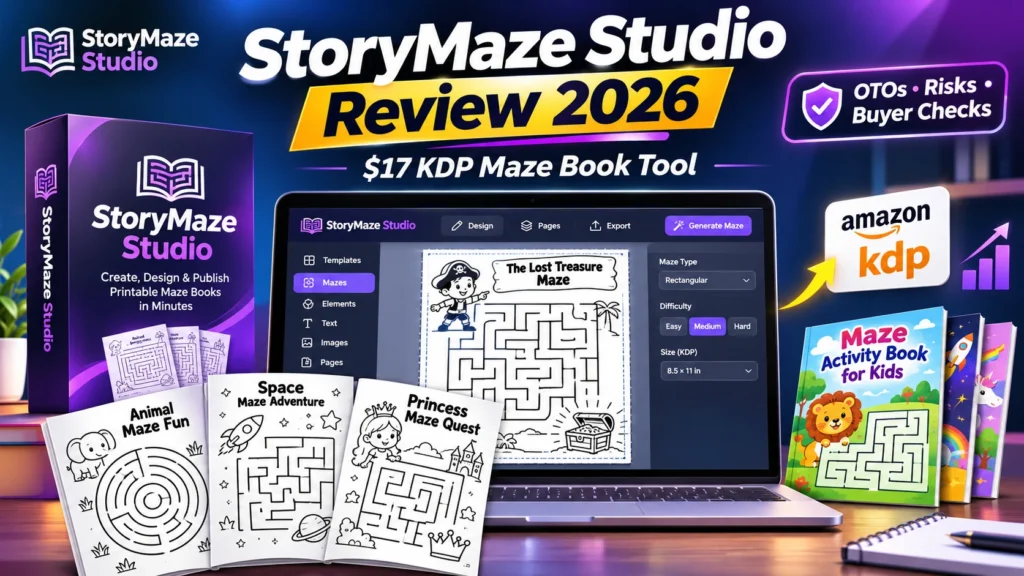
StoryMaze Studio review 2026: StoryMaze Studio is a newly listed browser-based activity-book generator aimed at Amazon KDP publishers. The vendor says it can produce story-driven maze books with character missions, a selection of themes, answer keys and print-friendly files. The launch page makes particularly strong originality and compliance claims, so this StoryMaze Studio review separates advertised features from what a publisher must verify personally before uploading anything to KDP.
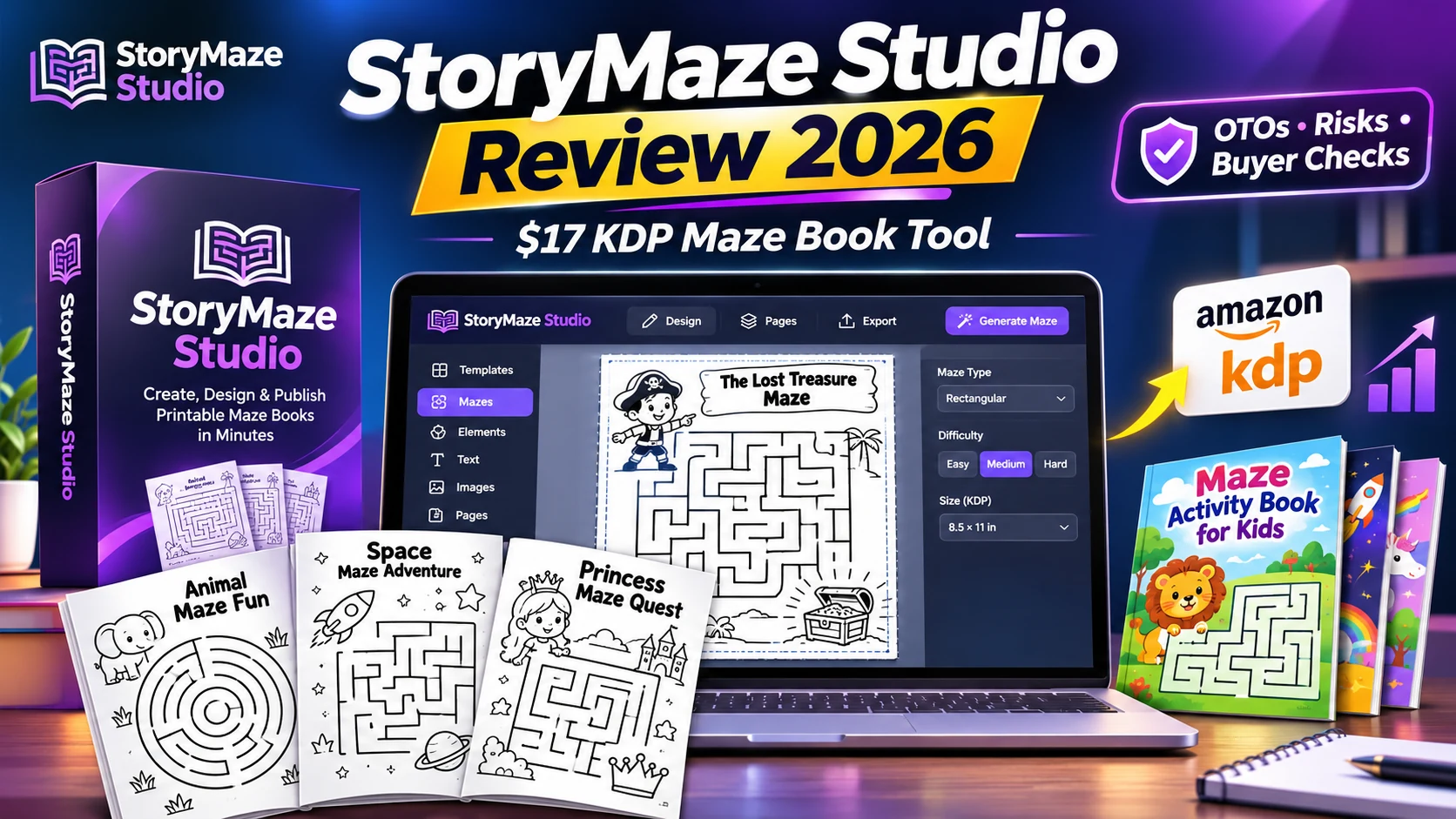
StoryMaze Studio review 2026 — Quick Verdict
StoryMaze Studio’s $17 entry product could interest publishers who want themed maze interiors rather than generic grids. However, a mathematical difference between maze paths is not the same as creative originality, marketplace eligibility, copyright clearance or a guarantee that an Amazon KDP book will be accepted. Treat every ‘publishing-ready’ claim as a starting point for quality control.
What Is StoryMaze Studio?
The vendor describes a browser workflow with five story settings—Space, Jungle, Cyberpunk, Ancient Egypt and Enchanted Forest—plus customized prompts, a canvas editor and PDF or PNG export. It describes 40-to-100-plus-page activity books, with answer keys and story elements attached to puzzles. Those are seller claims. We did not independently generate or upload a book through the software.
StoryMaze Studio Review 2026: Pricing, Features and OTOs
Price reference checked on November 15, 2026: $17 vendor-listed front end; four optional upsells listed separately. These are vendor/launch descriptions. Prices, available checkout options, licenses and refund rules may change without notice.
Maze and narrative generation
The sales material references a randomized depth-first-search/backtracking approach for mazes and narrative permutations. This may vary individual outputs, but sellers should compare several exports to test visual repetition.
Themes and page structure
Five built-in themes are advertised. A buyer should inspect whether the pages form an intelligible story, whether solutions are solvable and whether difficulty remains appropriate for the intended age group.
Front-end output
The vendor lists PDF and PNG export, personal/commercial use and an entry price of $17. Confirm commercial rights and export resolution in the current seller terms.
Upsell 1
A $37 Pro Unlimited & Vector Exporter upgrade is advertised with batch tools, SVG/EPS vector output and greater generation capacity.
Upsell 2
A $47 Multi-Puzzle Suite is described as adding Sudoku, crossword and word-search formats. Verify puzzle accuracy separately from maze generation.
Upsell 3 and 4
The vendor lists a $37 graphics-and-cover vault and a $97 reseller or agency license. Reseller rights are not the same as ownership of the underlying software.
StoryMaze Studio Review 2026: Which Package Fits?
Maze-book creators should separate basic output, print-production quality and rights. The advertised upgrades address different needs, and none removes your obligation to proof the interior.
| Buyer situation | Potential fit or limit | Recommended check |
|---|---|---|
| First test activity book | Entry offer is advertised at $17 | Export and manually solve a short sample before listing. |
| High-resolution vector workflow | Seller advertises SVG/EPS in a separate Pro upgrade | Check output editability and line quality before paying $37 extra. |
| Multiple puzzle types | Multi-Puzzle Suite is advertised separately | Validate Sudoku, crossword and word-search answers independently. |
| Service provider or reseller | Additional commercial or agency terms are marketed | Confirm whether rights cover the final books, templates or software itself. |
Do not confuse a randomly varied maze with a commercially distinctive book. Check difficulty, solvability, printed contrast, trim settings and any marketplace content-disclosure requirements.
Who Should Consider This Tool?
This product is best considered by a buyer who already understands the target workflow and can check its output quality. Beginners should start with one small project, keep independent copies of finished assets, and make purchase decisions from specific features rather than from income screenshots or launch countdowns.
Eight Practical Checks Before You Buy
1. Export a small test book
Create a 12-to-20-page test set before committing to a hundred-page interior. Review page margins, trim size, bleed requirements and image quality.
2. Solve every puzzle
Keep the answer key separate and manually solve sample mazes. Look for impossible paths, isolated start points and wrong answer markings.
3. Check story continuity
Readers should be able to follow the hero, objective and difficulty level. Randomized themes alone do not make a coherent activity book.
4. Assess creative duplication
Generate the same brief multiple times, overlay page samples and compare with known marketplace templates. Uniqueness claims need more than random seed variation.
5. Verify print specifications
Inspect embedded fonts, line weight, grayscale contrast and PDF trim. A ‘300 DPI’ export claim does not assure that every image asset or cover is print-safe.
6. Review rights and AI disclosure
Read the exact commercial-use, image-rights and KDP disclosure requirements before listing the book. Amazon can update its policies.
7. Calculate full costs
The $17 entry price should not be mistaken for the full advertised funnel. Decide whether the vector, cover and commercial-rights features are actually necessary.
8. Order a physical proof
Use a proof copy where available. On-screen puzzle clarity often differs from a printed children’s book.
Pros and Cons
Potential advantages
- Story-driven puzzle format is more specific than generic one-click book marketing.
- Seller lists several export and theme choices.
- Potentially useful for creating draft activity-book interiors for manual refinement.
Important limitations
- Claims of automatic KDP compliance and uniqueness are unproven.
- Four upgrade tiers may substantially raise total costs.
- Puzzles, covers and print settings still need independent quality checks.
- A browser export is not a substitute for publishing rights or a physical proof.
Alternatives and Related Reading
Use these related tutorials and product reviews to compare the workflow before buying.
Related reviews: KDPGlobal AI review and BookPilot buyer checks.
Independent educational guides: Amazon KDP AI content rules and AI-generated images and copyright guide.
Source checking: StoryMaze vendor launch description and Amazon KDP documentation. Product features attributed to a vendor are not the same as results independently verified in our account.
StoryMaze Studio Review: Plan a Printable Maze Book Before Generating
Start with a clear reader profile rather than producing 100 puzzles immediately. A maze book for early readers needs wider paths and simpler instructions than one for adults. Pick a theme, an age range, a trim size and an approximate number of puzzle pages. Write a short progression: introduce a character, explain a destination, increase difficulty gradually and end with a satisfying resolution. When story pages and maze pages are mixed, verify that the narrative continues logically between them rather than jumping between unrelated settings.
In a sensible StoryMaze Studio review experiment, generate only a dozen pages first. You should be able to describe what each puzzle asks the reader to do, which answer key matches it and why that page belongs in the sequence. Avoid automatic page duplication merely to increase book thickness. A smaller coherent puzzle book can be easier to review and more valuable to its intended audience than a large PDF full of repeated layouts. Previewing the real output matters more than the vendor’s advertised maximum page count.
Maze Solvability and Difficulty Quality Assurance
Every maze must have an obvious starting point, a clear destination and at least one valid solution. Random maze-generation techniques do not by themselves prove that instructions, illustrations or answer keys are correct. A good spot-check can involve tracing the route from start to finish with a pen, then comparing it with the generated solution. Also look for unintended open borders, tiny dead-end marks that may print unclearly, or routes that depend on crossing an illustration.
For children’s books, do not equate a visually dense maze with a fair challenge. Progression should involve purposeful complexity, with easier tasks near the beginning and more involved puzzles after the reader learns the format. Have another person solve the sample without verbal hints. Record the number of errors and the time required. If the reader cannot find the starting marker or a printed wall interrupts the path, fix the artwork before making more pages. The software’s role is to accelerate drafting, not replace editorial review.
Amazon KDP Print Files: Trim, Bleed and Proofing
Before exporting, confirm the intended trim dimensions, required interior margins and whether images extend to the edge of the page. A file described as print-ready still has to meet the printer’s technical checks. Narrow maze lines can disappear in a physical proof, especially with grayscale printing or inexpensive paper. Equally, large dark backgrounds may use excessive ink and can reduce contrast. Check that all puzzle labels, numbers and solution markers remain clear at printed size.
Open the PDF in an independent viewer, inspect page dimensions and font rendering, and check for empty pages or unintended page breaks. If the generator produces cover artwork, review cover dimensions and spine requirements separately from interior formatting. Ask for a print proof where the publishing platform supports one. Do not upload a batch of unreviewed interiors and rely on an automated compliance message. KDP review also covers content quality, metadata and rights matters that a standalone maze creator cannot guarantee.
Originality, Copyright and AI-Related Claims
The seller’s claims about randomized paths and different stories should be treated as descriptions of a generating process, not promises of legally protected original authorship. Two outputs may have different wall arrangements but nearly identical covers, settings and text. Compare a batch side by side and search for similar commercially available puzzle books before choosing a final concept. Use your own distinctive character designs, learning objectives and editorial improvements to avoid making a generic commodity interior.
Check which generated assets come from AI models, licensed clipart, stock graphics or predesigned templates. Read the terms for commercial use, resale and sublicensing, and do not assume that every bundled cover can be sold without restrictions. Publishers must still satisfy the current Amazon disclosure and quality policies. A StoryMaze Studio review that skips these rights questions may create more business risk than any amount saved on a design subscription. Keep records of prompts, licenses and proof corrections for future reference.
Total Cost of the Entry Plan and Four Upsells
The advertised $17 front end is only one possible cost. The listed Pro export, multi-puzzle, graphics and reseller offers target distinct workflows. You do not need every add-on to test whether the core generator makes a solvable maze. Make a written budget that names each required capability rather than buying the entire funnel at once. For example, an author who only needs an ordinary print PDF might not benefit from EPS export; a vector-focused print shop may have a stronger reason to investigate it.
Do not add the upgrades to a cost model as if their checkout prices were immutable. Launch pricing and bundle contents can change quickly. Confirm the exact current purchase terms, update policy, technical support and whether an advertised license is personal, commercial or reseller. Ask if purchasing a later upgrade preserves previous access and whether refunds apply separately to each item. The StoryMaze Studio review verdict is much clearer after a basic paid test demonstrates reliable printable output.
A Seven-Day Validation Plan for First-Time Publishers
On day one, select a single audience and create a list of required themes and puzzle difficulties. On day two, generate a small draft set and inspect its answer keys. On day three, manually improve instructions and title pages. On day four, build an interior PDF in your intended trim size. On day five, check print settings and any required content disclosures. On day six, obtain independent feedback from someone who was not involved in generating the pages. On day seven, evaluate the remaining quality problems and total time spent.
Success in this experiment means a usable, legally appropriate book draft, not a claim that the tool will produce passive income. A storefront listing requires its own cover, accurate product description, transparent metadata and audience research. If the trial exposes repeated unsolvable paths or confusing licenses, resolve those issues before spending on bulk-export features. This deliberate approach lets a beginner use automation without sacrificing the standards of a publishable activity book.
Questions About StoryMaze Studio That Sellers Should Answer
Request a real sample export with an answer key, a cover preview, dimensions and source-file details. A marketing claim that mazes are generated algorithmically does not verify that the instructions are readable or that the files meet any specific print standard. Ask whether each generated page is created from editable vector paths or raster graphics in the core package. Confirm the maximum working page count, any export limit and whether the solution pages are numbered in the same order as the corresponding puzzles. If the output is described as 300 DPI, determine which page components are actually exported at that resolution.
Ask how the software handles age-based difficulty, whether users can inspect and correct invalid paths, and whether an existing project is editable after export. The marketed upgrades should have a feature-by-feature entitlement list. Does the Pro tier change exports, generate more mazes, or do both? Does a reseller tier grant rights to software access, to finished books, or merely to promotional materials? Put these questions in writing and keep the answer with your license receipt. This is more useful than making a purchase decision based on the percentage discount shown by a launch timer.
Production and Marketplace Quality Checklist
Work through a final checklist before uploading any book: every maze has a start, destination and valid answer; every title and caption is legible; page numbering is consistent; the interior has safe margins; the cover reflects the real content; and the publisher owns or licenses the art used. Recheck a randomly selected portion of the PDF after every bulk edit, not just the first page. If a print proof reveals weak lines or cramped writing space, revise the source and order another proof rather than accepting a poor first version.
Evaluate the final product using the experience of its target reader. For children, consider whether instructions are understandable without adult intervention. For teachers, check whether the answer keys are easy to locate and whether the puzzle themes support an age-appropriate learning goal. The StoryMaze Studio review should lead to one well-tested activity book, not a large catalog of low-quality files. Once that process works reliably, only then calculate whether additional puzzle types, vector export or broader commercial rights would save enough effort to justify their price.
Our Verdict
StoryMaze Studio may be worth a controlled $17 trial for activity-book creators who can audit their own output. We would not advise publishing an unreviewed batch to KDP, and we would not pay for a reseller upgrade until the front-end puzzles prove reliable. This article is based on seller documentation, not an independent hands-on test.
Frequently Asked Questions
Does StoryMaze Studio guarantee Amazon KDP approval?
No software can guarantee KDP approval. The creator is responsible for content quality, rights, metadata and policy compliance.
Does the $17 plan include vector export?
The vendor’s launch breakdown places SVG/EPS and unlimited or batch features in a separate Pro upgrade, not the core front end.
What activity books does it create?
The main product is positioned around story-driven maze books. The separate Multi-Puzzle upgrade advertises additional types.
Can I resell the software?
Only if you purchase the specific reseller/agency rights and those rights match your planned business model.
Can I use AI images in KDP books?
Check current KDP content-disclosure requirements and the rights attached to each generated or sourced image.
Editorial disclosure: This is a research-based buyer guide, not a hands-on product test. We do not promise results, savings, traffic or earnings. Links in this draft direct to the identified vendor or launch pages; tracking-link approval and current checkout terms must be verified before publication.