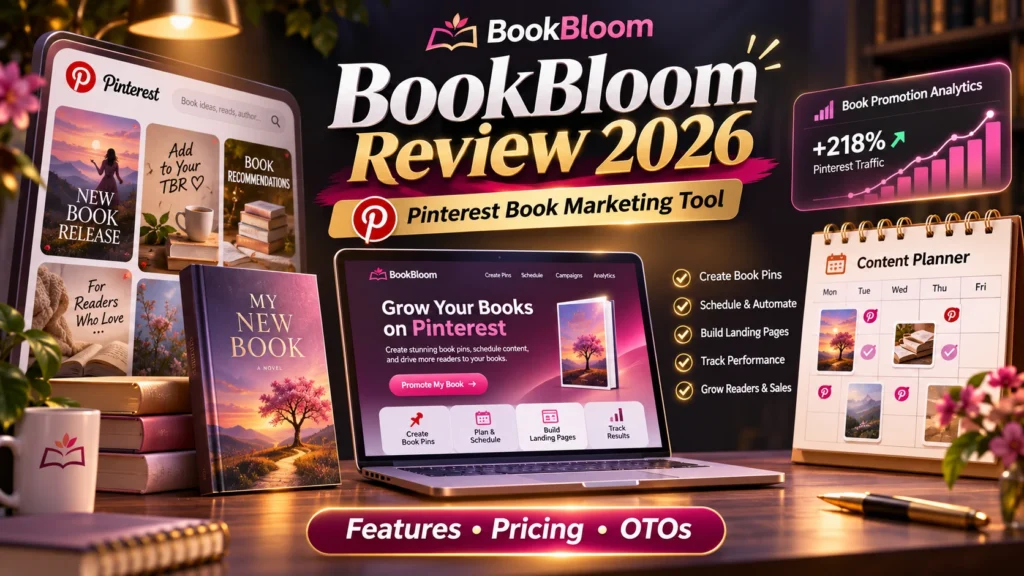
BookBloom review 2026 — BookBloom targets a neglected part of self-publishing: promoting a finished book after it goes live. The vendor says authors can supply an Amazon book link, generate a month of Pinterest pin artwork and captions, review a dated campaign, and export it for publishing. Its advertised entry price is $17 one time, but the operating model needs the buyer’s own AI key and the sales funnel offers five optional upgrades. This BookBloom review 2026 separates the useful production workflow from the suggestion that pin creation itself produces book sales.
Editorial note (updated November 13, 2026): This is a source-verified research review, not a claimed personal purchase or hands-on benchmark. Pricing and platform details may change. CTA links go to official public vendor pages and are not approved affiliate-tracking links.
BookBloom: quick facts and buyer verdict
| Detail | Verified / qualified information |
|---|---|
| Provider | Demetris Papadopoulos (DPAPA) / LimitlessPassion Ltd |
| Platform | WarriorPlus |
| Launch | November 13, 2026 |
| Entry | $17 one-time, vendor sales page |
| Additional cost | Own AI provider key; image-generation use varies |
| Main buyer | Self-published book authors using Pinterest |
| Testing disclosure | Vendor documentation reviewed; no independent paid-account benchmark |
A Pinterest campaign does not become useful just because it contains thirty graphics. Authors need a relevant book, accurate descriptions, consistent visual branding and a destination where readers can learn more. The interesting promise here is reducing repetitive production work; the missing proof is whether those assets attract the right readers.
What BookBloom actually does
BookBloom targets a neglected part of self-publishing: promoting a finished book after it goes live. The vendor says authors can supply an Amazon book link, generate a month of Pinterest pin artwork and captions, review a dated campaign, and export it for publishing. Its advertised entry price is $17 one time, but the operating model needs the buyer’s own AI key and the sales funnel offers five optional upgrades. This BookBloom review 2026 separates the useful production workflow from the suggestion that pin creation itself produces book sales. A Pinterest campaign does not become useful just because it contains thirty graphics. Authors need a relevant book, accurate descriptions, consistent visual branding and a destination where readers can learn more. The interesting promise here is reducing repetitive production work; the missing proof is whether those assets attract the right readers.
BookBloom: seven features and real limitations
1. Amazon book-link intake
The vendor describes starting with a book’s Amazon link rather than a complicated creative brief. That may import a title, cover and summary, but an author must check metadata, genre, promises and any review text before using it in advertising. A book page may contain edition differences and details that need careful selection.
2. Pin art with multiple creative angles
The page promotes six preview styles, AI artwork inspired by the book and editable text. For fiction, angles could focus on setting, genre mood or reading experience; for nonfiction, a pin could highlight a specific educational outcome. Avoid reproducing trademarked cover art beyond your rights or using misleading claims about the book.
3. Thirty-day content calendar
A prepared monthly schedule helps authors avoid inconsistent posting. However, a calendar is a plan, not distribution: check which publishing actions happen in the product and which happen manually through Pinterest. A good test is whether the exported calendar can be revised without starting over.
4. Caption and hook customization
The sales page describes hooks, supporting lines and full captions. Personalization matters because readers search differently for romance, cozy mystery and children’s activity titles. Do not keep boilerplate hooks that promise a book will transform someone’s life or guarantee results.
5. Landing page owned by the author
A standalone promotional page can connect a pin to retailer links, a summary, author details and an opt-in. Confirm how the page is hosted, what happens if the account closes and whether the author can export all assets and maintain a canonical destination.
6. Book promotion finder
The vendor advertises a catalog of free submission opportunities with eligibility rules. Authors should open the actual listing sites, confirm each site’s current rules and ensure the promotions apply to their genre, pricing and region before submitting.
7. Multi-book website and export
BookBloom also describes growing single-title pages into an author site for multiple books. That might save initial setup time, but exporting HTML is not the same as managing hosting, backups, search indexing or GDPR/consent requirements for an email signup.
How to evaluate BookBloom in seven practical steps
This is a reproducible test plan, not a fictional result from a purchased account. Use real facts, authorized assets and a small project; do not accept attractive output until its quality and rights are checked.
Step 1: Choose one book and one reader problem
Use an existing, published title and write down its real genre, premise, audience and unique appeal. Do not build a campaign from speculative sales benefits.
Step 2: Verify book metadata before generation
Cross-check title, cover, edition, retailer URL, authorship and synopsis against the Amazon listing. Incorrect book facts can reduce trust immediately.
Step 3: Generate several creative directions
Create different graphic angles: one cover-led, one question-led and one genre mood-led. Don’t publish thirty near-identical pins. Verify typography and readability at actual phone dimensions.
Step 4: Write search-intent captions
Use natural reader queries rather than keyword stuffing. For example, ‘cozy winter mysteries’ matches a different audience from ‘how to solve logic puzzles’.
Step 5: Build or link a useful landing page
Include actual descriptions and available retailer destinations. If you collect email addresses, add a clear privacy notice and opt-in consent.
Step 6: Export and schedule responsibly
Test the spreadsheet or calendar file with the exact Pinterest workflow in use. Ensure the artwork, destination links and dates are all preserved.
Step 7: Measure a complete campaign
Compare impressions, outbound pin clicks, book page visits and attributable sales separately. High pin reach without a retailer click is not successful book promotion.
BookBloom pricing, extras and the real total cost
The entry price alone is not the total cost. External API credits, hosting, paid advertising, optional upgrades and staff time may all change whether a launch offer is good value. Verify prices on the current checkout screen before committing.
| Tier / expense | Advertised amount | Buyer guidance |
|---|---|---|
| Front end | $17 one-time | Core month-of-pins workflow; no promised recurring software fee. |
| AI usage | Variable | Bring your own AI key; vendor charges do not cover provider usage. |
| Video Studio / publishing | Optional OTO | Adds capabilities above core; confirm live checkout. |
| Traffic and free-channel tools | Optional OTO | Verify eligibility data, posting rules and quotas. |
| Amazon Ads builder | Optional OTO | Ad spend and account approvals remain separate. |
| Reader-list tools | Optional OTO | Understand contact consent, mail limits and hosting. |
| Agency tools | Optional OTO | Verify resale rights and client licenses. |
| VIP bundle | Advertised around $197 in third-party review | Confirm vendor checkout and exact bundle contents. |
BookBloom: advantages and tradeoffs
| Potential strength | Important limitation |
|---|---|
| Amazon book-link intake | A one-time software license is not a promise of free image or text generation. Keep API credentials private and measure actual per-campaign spending. |
| Pin art with multiple creative angles | Repetitive, overly promotional or misleading pins can lose distribution or violate platform policies. Use an authentic author account with useful pins. |
| Landing page owned by the author | Confirm copyright for cover art, generated images, fonts and promotional assets for the territories where you publish. |
| Single tool focused on one workflow | A tool cannot guarantee search rankings, book sales or affiliate earnings. |
Three realistic BookBloom use cases
Cozy mystery launch
Plan ten distinct themes across character, setting, reading mood and genre. Publish them to relevant boards at a steady pace; use the same link-tracking method for comparisons.
Activity book for parents
Show real sample activities with rights clearance, age-appropriate descriptions and the actual format. Avoid fake page previews that do not exist in the published book.
Nonfiction backlist refresh
Revive older titles by building educational pins around real chapters and questions. Refresh stale landing pages before driving visits so readers arrive at a useful destination.
Nine checks before buying BookBloom
1. Bring-your-own AI key
A one-time software license is not a promise of free image or text generation. Keep API credentials private and measure actual per-campaign spending. Write down what the vendor actually guarantees and save any important checkout wording for your records.
2. Pinterest account policies
Repetitive, overly promotional or misleading pins can lose distribution or violate platform policies. Use an authentic author account with useful pins. Write down what the vendor actually guarantees and save any important checkout wording for your records.
3. 30-day guarantee terms
The vendor describes a first-campaign guarantee requiring a genuine campaign and proof of publishing, not an unconditional instant refund. Write down what the vendor actually guarantees and save any important checkout wording for your records.
4. Sales attribution
Outward clicks do not prove book sales. Track retailer URLs, campaign tags and periods carefully. Write down what the vendor actually guarantees and save any important checkout wording for your records.
5. Cover and image rights
Confirm copyright for cover art, generated images, fonts and promotional assets for the territories where you publish. Write down what the vendor actually guarantees and save any important checkout wording for your records.
6. KDP listing integrity
Do not change claims, categories or contents without checking retailer rules. Pin copy should represent the actual book. Write down what the vendor actually guarantees and save any important checkout wording for your records.
7. Exports and ownership
Ensure campaigns, landing pages and your email list remain usable outside the vendor dashboard. Write down what the vendor actually guarantees and save any important checkout wording for your records.
8. Upgrade overlap
Do not buy all upsells unless you need agency licensing, ad tooling or repeat scheduling at scale. Write down what the vendor actually guarantees and save any important checkout wording for your records.
9. Real workload
A tool that writes pins does not remove the need for proofing, scheduling, creative refreshes and measurement. Write down what the vendor actually guarantees and save any important checkout wording for your records.
Who should buy BookBloom, and who should skip it?
Buyers who already have the required inputs, understand the relevant platform and can review the output manually are better positioned to benefit. A beginner should evaluate one narrow use case before buying any OTO. Anyone expecting fully automatic income, guaranteed organic exposure or a replacement for professional review should not purchase based on promotional language alone.
A reasonable decision rule is to test a complete deliverable, calculate its cost, inspect licensing and support, and compare the result with tools already owned. If the offer does not save meaningful work or make outputs better, the lower entry price does not justify extra spending.
Related reviews and practical guides
Read PublishFlow KDP Studio review and BookPilot review for adjacent buyer decisions on AIReviewDock.online.
For longer-term SEO and compliance decisions, see Amazon KDP AI-content rules and affiliate tracking checklist on our separate educational site.
BookBloom frequently asked questions
Is BookBloom a $17 lifetime deal?
The vendor advertises a $17 one-time front-end license. Separate optional upgrades and external AI API usage can increase total cost.
Will BookBloom post every pin automatically?
The sales page emphasizes author approval and calendar export. Confirm which exact tier supports any in-app publishing before relying on unattended posting.
Does BookBloom guarantee Amazon sales?
No. The product can prepare promotional materials; sales require relevant audiences, a convincing listing and effective distribution.
Can authors use their own AI account?
The seller states the software uses the customer’s AI key. Check supported providers, per-image costs and safe key storage.
What does the refund policy require?
The advertised 30-day first-campaign guarantee may require creating and publishing a genuine campaign. Read the current checkout terms.
Is BookBloom useful with several KDP titles?
The marketing page mentions multi-book sites and a ten-book workflow. Check limits and whether agency use is separately licensed.
BookBloom review 2026: realistic campaign budget and results worksheet
A book-marketing application should be evaluated through a simple commercial worksheet. For example, consider a paperback with a hypothetical $3 royalty per order. If the BookBloom front end costs $17 and the buyer spends another $5 on AI credits, the upfront cash expenditure is $22. The simple break-even count is eight additional royalty-paying copies, because 7 × $3 is only $21. This is example arithmetic, not a prediction of orders, and it excludes the author’s labor, taxes, refunds and any promoted pins.
| Measurement | Example only | What the author must record |
|---|---|---|
| Base software | $17 upfront | Actual approved checkout amount |
| AI API use | $5 assumed | Real provider billing, not seller estimate |
| Extra cost | $0 assumed | Purchased OTOs, hosting, ads if any |
| Total assumed cost | $22 | All direct cash costs |
| Royalties per sale | $3 assumed | Author’s actual royalty report |
| Break-even units | 8 additional sales | Incremental sales plausibly tied to campaign |
Clicks can be tracked more directly than orders. Use separate campaign-tagged landing-page links for different pin designs where possible, record the click-through rate and check whether readers reach the right retail edition. Do not equate Pinterest impressions with site visitors or royalties. A cover that receives lots of saves may be interesting but still fail to create book-page visits.
How to compare a campaign before and after BookBloom
- Choose one title and note seven days of existing Pinterest profile activity without changing its content strategy.
- Publish a limited set of six new BookBloom-supported creatives over the next week, using distinct descriptions and accurate cover imagery.
- Keep a spreadsheet of publication date, pin URL, topic angle, impressions, outbound clicks and time spent editing.
- Use the same landing-page destination or consistent UTM naming for comparable pins; avoid mixing several unrelated changes.
- Evaluate the change in outbound clicks and engaged visits first, then review retailer-side sales with attribution limitations stated.
BookBloom versus a manual Pinterest workflow
| Decision | BookBloom approach | Manual approach |
|---|---|---|
| Artwork | Seller describes AI-assisted pin designs | Canva or existing design editor |
| Caption | Editable generated hooks and copy | Written by author using reader keywords |
| Schedule | 30-day calendar with export | Spreadsheet and Pinterest’s tools |
| Book page | Vendor advertises exportable landing page | Author site or retailer listing |
| AI cost | External API key and consumption | Only if author uses paid AI tools |
| Best reason to choose | Repeatable workflow if outputs are usable | More control with fewer services |
The useful alternative is often a simple spreadsheet and a standard image editor. The advantage of BookBloom would be consistency and saved preparation time, not a secret traffic source. A first-time author should measure how long six finished pins take with each approach, whether the results meet the book’s tone, and whether future campaigns remain editable.
BookBloom review 2026: editorial proof and launch conditions
Before using the product for client work, inspect the vendor’s refund conditions, campaign export formats, and any client-use license. The 30-day campaign guarantee has participation requirements; treat it as a conditional refund offer, not a no-questions trial. Also check that generated promotional images do not alter the actual book cover or claim awards, rankings and endorsements the author cannot prove.
A responsible BookBloom review 2026 should also distinguish a marketing demonstration from independently observed sales. The images in this article are conceptual artwork and cannot establish customer results. Current Pinterest policies and retailer guidelines still apply even if the vendor automates design and scheduling.
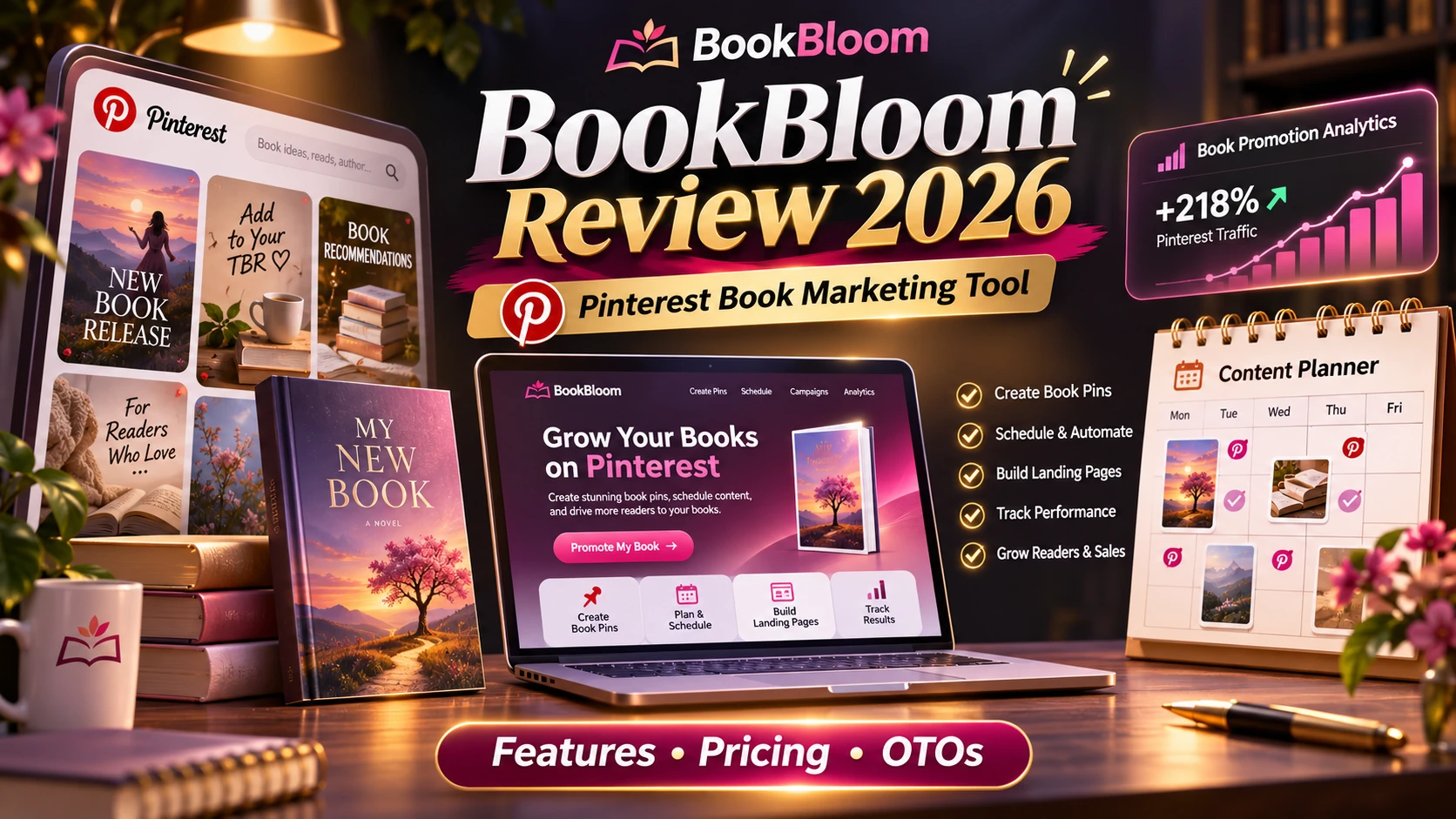
Featured artwork for this BookBloom review
The illustration below depicts the kind of campaign workflow discussed in the article. It is not a screenshot from a purchased account.
Final verdict: is BookBloom worth it?
BookBloom is a plausible starting point for authors who need a repeatable Pinterest promotion system and already own a real book. The $17 entry looks approachable, but independent ROI is unproven and the refund has campaign conditions. Start with one book, prove a usable export, and measure outbound retailer clicks before purchasing upgrades.
No earnings, ranking position, launch approval, sales uplift or traffic improvement is guaranteed. Our review is intended to support an informed decision, not to substitute for a trial, current checkout terms or direct customer support.
Sources and editorial methodology
Checked November 13, 2026: official vendor product information and Pinterest creative and pin best practices. Features and prices attributed to vendors are not presented as independently tested outcomes.